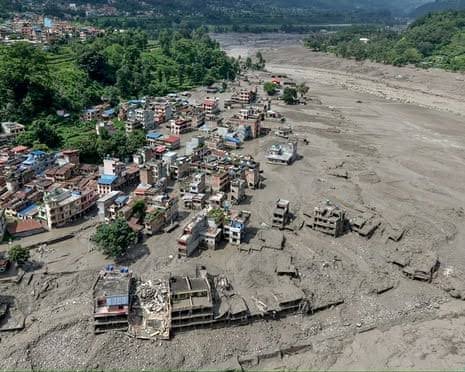
Kathmandu, Sep 10,2026: The Nepal government estimates that over NPR723.31 billion ($4.74 billion) will be needed to recover from the damages suffered in the wake of the devastating floods in the Bhotekoshi River area of Rasuwa on August 26. The figure comes from a Rapid Damage and Needs Assessment prepared by a joint technical team from the National Planning Commission and the National Disaster Risk Reduction and Management Authority. Of the total, NPR473.57 billion ($3.10 billion) is expected to be required to restore infrastructure, which accounts for about 75% of overall recovery needs.
Bengaluru (Karnataka), September 9,2026: Group Captain and astronaut Angad Pratap on Wednesday said Gaganyaan will lay the foundation for India’s larger human spaceflight ambitions, including the Bharatiya Antariksha Station, stressing that the country’s ultimate aim should be to make space accessible to everyone and push the boundaries of knowledge for humanity.Speaking at the Space Expo session ‘The Next Chapter of Space: A Conversation on Exploration, Science and Innovation’, Pratap said Gaganyaan is about developing India’s independent capability to send humans into space and described it as a major technological milestone.“Gaganyaan is about acquiring the capability to launch a human to space domestically, here in India. It’s a huge capability, and I am very, very eagerly waiting for that day to happen. Because it is a very critical piece of what I would call apex technology, which has 16 to 20 very niche sets of technologies under it. So once you reach that milestone, it is a huge milestone for any country in the world, and we are going to be the fourth country in the world to do that, all by ourselves,” he said.
However, he said India’s human spaceflight ambitions should not be limited to Gaganyaan, pointing to the Bharatiya Antariksha Station as an important part of the country’s long-term plans.“Notwithstanding that, I wouldn’t really restrict myself to Gaganyaan, because in India people currently associate human spaceflight only with Gaganyaan. The Bharatiya Antariksha Station is still in the shadows. So Gaganyaan is nothing but human spaceflight,” Pratap said.He said human spaceflight would allow scientists to expand knowledge beyond what can be learnt by observing phenomena on Earth.“And for those from a physics background, you know about the physics cube. All of the learning we have had, whether in the biological domain or the engineering domain, we have learned primarily by observing things here on Earth. There is much, much more to learn out there, beyond Earth, for which you have to send your scientists. You have to send humans of all specialisations — who are probably sitting right here — all the way up there,” he added.Pratap said Gaganyaan should therefore be viewed as a foundation for much larger human spaceflight programmes. “So Gaganyaan may sound like just one single capability or a technology demonstrator where we just send one person, for one orbit maybe, and bring them back. But that will lay the foundation for much bigger things that I have already talked about, and Tom has already talked about,” he said.He also stressed the need for greater collaboration between the government and private sectors in India’s space programme.“We need to make space accessible to everyone. A lot of technology will cross over between the private sector and the government sector — it’s a symbiotic relationship, and both will gain from each other. But the ultimate aim is to push the boundaries of knowledge for humanity as a whole,” he added.
The session featured Sunita Williams, retired US Navy officer and NASA astronaut and Tom Shelley, Vice President, Crew Partnerships, VAST Space, who discussed the future of space exploration, science, innovation and commercial space stations.NASA astronaut Sunita Williams said India is “ready for the challenge” of building future space stations, while stressing that advanced technologies, autonomous systems and international cooperation will be critical as human spaceflight moves beyond the International Space Station (ISS).Williams said the next generation of space stations offers an opportunity to develop systems that can reduce dependence on Earth, including onboard databases, reliable 3D printing and autonomous scientific analysis. Reflecting on her experience aboard the ISS, Williams said astronauts cannot simply rely on a database or search engine in space in the same way people on Earth can.
Moscow, Sept 8,2026: Artificial intelligence poses an existential threat to humanity, which must be addressed promptly, UN High Commissioner for Human Rights Volker Turk said. “I share the concerns of industry insiders that advanced AI could pose an existential risk to humanity … I am calling here, today, for an all-out effort to put cast iron guarantees in place around the safety and security of AI, before it is too late,” he said at the 63rd session of the Human Rights Council, as quoted by his office on Monday.
Turk added that he would send a corresponding letter to all leading AI development companies in the coming days. At the same time, he said that only a handful of people hold “almost unlimited power over AI.”
“At a minimum, we need countries hosting AI and those involved in its supply chains to come together around agreed red lines,” Turk said. In December 2025, Chief Economist for the Asia-Pacific Regional Bureau of the United Nations Development Programme (UNDP), Philip Schellekens warned that the military application of AI could pose an existential threat to humanity and lead to mass casualties, stressing the need for highly responsible regulation.
HORROR’ AT AUTONOMOUS DRONES
“I share the concerns of industry insiders that advanced AI could pose an existential risk to humanity,” Turk told the body in Geneva.
“I am calling here, today, for an all-out effort to put cast-iron guarantees in place around the safety and security of AI, before it is too late.”
Turk did not elaborate on the nature of the risks but a spokesperson for his office said failures involving powerful AI systems could disrupt critical infrastructure and democratic institutions.
She referred to the “dangerous agent-training behaviours” in July’s so-called Hugging Face incident where a swarm of OpenAI agents hacked an open-source platform, saying it suggested that frontier AI capabilities are advancing faster than the safeguards.
Turk warned that just a handful of men held “almost unlimited power over AI” without naming any. Top AI companies include Meta, Anthropic, OpenAI and Google(GOOGL.O).
“At a minimum, we need countries hosting AI and those involved in its supply chains to come together around agreed red lines,” he said.
In January 2025, UN Secretary-General Antonio Guterres called uncontrolled AI an existential threat, alongside climate change and nuclear weapons.
DUBAI, Sept 7,2026: Iran said it will announce a new restricted zone in the Gulf in the coming days, along with maps of a new shipping corridor through the Strait of Hormuz.
The new restricted zone will begin from where the U.S. blockade of Iran begins and extend into areas of the Gulf, Mohsen Rezaei, the secretary of Iran’s Supreme National Security Council, said on Sunday in an interview with state TV.
Few details were provided on the plan, but Rezaei said any ship entering the new zone would be added to a sanctions list.
In addition, maps detailing passage routes for the Strait of Hormuz, a vital energy conduit largely closed to tanker traffic, would also be approved soon, Rezaei said.
“The maps of a new international corridor which lies in Iranian and Omani waters and in which Iran will have management have been agreed and should be signed in the coming days,” he said.
“We will only commit to the Strait of Hormuz being open when they (the Americans) stop the sabotage, threats and attacks on Iran,” Rezaei added.
Six months after U.S.-Israeli strikes on Iran sparked the war, the conflict appears to be at a stalemate. A preliminary ceasefire accord reached in June has unravelled, and little progress has been made in diplomatic efforts to get the peace process back on track.
After a pause in military action for much of August, tit-for-tat strikes have resumed. U.S. forces struck three Iranian oil tankers on Saturday, U.S. Central Command said, including one off Kharg Island, Iran’s key oil export hub, following attacks by Iran’s Islamic Revolutionary Guard Corps on U.S. warships in the region.
Tehran has shown it retains the capability to attack U.S. interests in neighbouring countries and to shut down oil flows through the Strait of Hormuz, through which about a fifth of global oil supplies flowed prior to the conflict.
An average of 10 commodity ships transited the Strait per day in the past 10 days, the lowest since May, according to shipping data on Monday. That helped oil prices extend last week’s big gains, with Brent crude up 0.8% above $97 a barrel.
SANCTIONS, OIL BLOCKADE SQUEEZE ECONOMY
Iran has said it will step up efforts to tackle problems created by U.S. sanctions that are crippling its economy.
However, the U.S. campaign to throttle Iran’s economy by blockading its oil exports and stopping sanctions evasion is growing increasingly difficult to withstand, three senior Iranian sources have said.
Iran’s Parliament Speaker Mohammad Baqer Qalibaf said on Sunday that the U.S. should understand that the rules of the game have changed “before it is too late”.
“From now on, any attack against Iran’s interests and security will receive a faster, heavier and more painful response,” he said in a speech published on his Telegram channel.
Qalibaf said that alongside the military front, Iran’s main battle was now over production and people’s livelihoods.
He cited sharp currency fluctuations, inflation, unemployment and market management as major challenges, adding Iranians could tolerate hardship but not mismanagement or inaction and expected the government to act quickly.
Iran’s Economy Minister Ali Madanizadeh said Tehran planned to respond to U.S. economic pressure with reforms and rejected the notion that sanctions would cause it to change course, according to state media on Sunday.
“They speak of economic pressure and isolation, of breaking off financial ties and they think that by pressuring the economy of a country they can change the decisions of its people,” Madanizadeh said.
“I have to clarify one point: The responsibility of reforming Iran’s economy is with its government and people, not with the U.S. Treasury.”
KHARG ISLAND HIT 550 TIMES IN PRIOR MONTHS, IRAN SAYS
Iran is the third-largest producer in the Organization of the Petroleum Exporting Countries and exported 90% of its crude via its Kharg Island export hub before the war. Flows have been disrupted since a U.S. blockade of Iranian oil exports began in mid-April.
U.S. Central Command said on X that as of Sunday it had redirected 92 commercial vessels, disabled three and boarded two to ensure strict compliance with its blockade.
On August 31, U.S. President Donald Trump issued a one-line social media post accompanied by an AI-generated video depicting Kharg Island being “blown to smithereens.” Iranian authorities have vowed a strong response if Kharg is attacked.
In an interview aired on state TV on Sunday, Iran’s Oil Minister Mohsen Paknejad said the island had been hit around 550 times in previous months but continued to operate.
Iran’s blockade of the Strait of Hormuz has pushed up fuel prices, weighing on Trump’s popularity as his Republican Party heads into elections in November when control of Congress is at stake.
However, U.S. Energy Secretary Chris Wright said oil was getting through the waterway.
“Our transits through the Strait are averaging over 9 million barrels a day now, and with the access pipelines that go around the strait, we’re probably two-thirds or more of pre-conflict flows. So Iranians are still causing trouble, but the United States Navy is winning that battle,” he told CNN.
New Delhi, Sep 4,2026: The National Commission for Protection of Child Rights (NCPCR) has rescued more than 3,800 children as part of its nationwide “Pan-India Rescue and Rehabilitation” campaign aimed at protecting children from child labour, trafficking and exploitation. The campaign, launched on June 12 and continued until August 31, brought together State Governments and union Territory administrations, District Magistrates, Labour Departments, police authorities and other stakeholders to intensify efforts to identify and rescue children working in vulnerable conditions.
During the campaign, the NCPCR coordinated with State Governments and Union Territory Administrations, District Magistrates, Labour Departments, Police authorities and other stakeholders to intensify the identification, rescue and rehabilitation of children engaged in child labour and those vulnerable to trafficking and exploitation. The Ministry said that the NCPCR also held meetings with District Administrations to monitor the implementation of the campaign and address field-level issues.
The meetings focused on reviewing rescue operations, resolving operational bottlenecks, ensuring timely submission of Action Taken Reports and strengthening coordination among concerned departments and agencies. The Ministry said that the NCPCR also carried out awareness and outreach activities through social media and other communication platforms. These efforts focused on reporting child labour and highlighting the importance of rehabilitation and bringing rescued children back into the mainstream of education.
New Delhi, September 3,2026: India will announce the final details of its Bilateral Trade Agreement (BTA) with the United States only after Washington agrees to offer preferential tariff terms over India’s competitors, Commerce and Industry Minister Piyush Goyal said on Thursday.”As soon as the US is able to give us the preferential rate in comparison to our competition, we will finalise the BTA and announce the final details,” Goyal said, addressing a national workshop on Leveraging FTAs Outreach program.
The minister said the trade pacts India has already concluded are opening up significant export opportunities for domestic businesses.He added that India is on track to conclude several more trade agreements in the coming months and years, naming Canada, Mexico, Chile, the Brazil-led Mercosur bloc, the Southern African Customs Union (SACU), a South Africa-led group of nations, the six-member Gulf Cooperation Council (GCC), and Israel as prospective partners.India and the US have been holding talks for a mutually beneficial Bilateral Trade Agreement (BTA).During his June 22-24 visit to New Delhi, US Trade Representative Ambassador Jamieson Greer and Commerce and Industry Minister Piyush Goyal reviewed key elements of the agreement, including enhanced market access, digital trade, supply chain resilience, reduction of non-tariff barriers and cooperation in strategic sectors.Both sides had noted substantial progress by their negotiating teams and reaffirmed their commitment to an agreement that is balanced, commercially meaningful and delivers tangible benefits for businesses, farmers, workers and consumers in both countries.In February, India and the US had announced a framework for an Interim Agreement on reciprocal and mutually beneficial trade, reaffirming their commitment to the broader BTA negotiations.In the latest development in June, U.S. Trade Representative Ambassador Jamieson Greer led a delegation to New Delhi to meet Union Minister of Commerce and Industry Piyush Goyal, reviewing core BTA elements and pushing forward the interim deal.For 2025, India’s total goods exports to the U.S. reached USD 103.82 billion, while U.S. exports to India totalled approximately USD 45.6 billion, for a total bilateral trade of USD 149.42 billion.The bilateral services trade in 2025 was recorded at USD 92.23 billion, where India exported USD 48.67 billion worth of services to the US and imported USD 43.56 billion worth of services from the US.
Nuwakot [Nepal], August 31,2026: As devastating flash floods continue to affect parts of Nepal, local organisations and NGOs have also stepped up efforts to provide relief material and essential supplies to survivors in Nuwakot district.Small trucks were seen transporting relief material to flood-affected areas, with volunteers engaged in distributing supplies among people in need.
The Rastriya Sarokar Mancha Nepal, Kathmandu, under its ‘Karmanishtha Abhiyaan’ (Mission of Duty) campaign, has sent its third batch of relief material, focusing on food supplies, basic amenities and essential items for affected families.Speaking to ANI, Rastriya Sarokar Manch national spokesperson Pratik Joshi said, “This is part of our ‘Karmanishtha Abhiyaan’ (Mission of Duty) campaign. This is our third batch–the third vehicle. Our friends had also taken supplies from here previously; so, this is the third time we are bringing aid here. We have focused primarily on daily essentials–specifically food–and the most critical arrangements regarding food and accommodation.”
On the requirements of flood-affected people, Joshi said the government’s attention was currently focused on rescue operations, and citizens needed to come forward to support those affected.”The primary issue is that the government’s attention is currently divided due to the ongoing rescue operations. We believe that as Nepalis, we should step up to help fellow human beings. Since the government is unable to fully focus its attention there right now, we decided to make our own efforts to provide assistance,” he said.”Based on what our friends shared with us–specifically regarding the need for food supplies, decent sleeping arrangements, and addressing gaps in basic amenities–we decided to focus on these areas,” he added.
Nepal continues to deal with one of its worst recent flood disasters. According to the National Disaster Risk Reduction and Management Authority (NDRRMA), the death toll rose to 903 on Monday, while around 4,247 people remained missing. A total of 10,451 people have been rescued so far.Chitwan has reported the highest number of casualties at 272, followed by Nawalparasi East with 207, Nawalparasi West with 151, Nuwakot with 95, Gorkha with 62, Dhading with 55, Tanahun with 37 and Rasuwa with 24.The missing include security personnel, government employees, hydropower workers and foreign nationals. Nuwakot has reported 1,548 missing persons and Rasuwa 865, according to District Emergency Operations Centre data.Rescue operations are continuing on the ground and by air. The Nepal Army has conducted aerial rescues of 252 foreigners and 3,344 Nepali nationals, while 411 flights have been conducted as part of rescue and relief operations.On August 30, 15 people from a hydropower site, including five Chinese and seven Indian nationals, were rescued.Nearly 20,000 security personnel have been deployed for rescue operations. Ground teams have carried out 8,730 rescues, while helicopter operations have airlifted thousands of people from affected areas.
Caracas, Aug 30,2026: Venezuela’s interim President Delcy Rodriguez said that a landmark oil agreement with the United States will remain in effect for 25 years and aims to lift the country’s crude production to more than 1.5 million barrels per day, as Washington and Caracas move to deepen their rapidly evolving economic ties.
Rodriguez asserted that the country is preserving its sovereignty despite the announcement that it will hand over the rights to billions of barrels of its oil to the United States.
The “historic” deal with Washington to hand over 65 billion barrels of Venezuelan oil will last 25 years and allow Venezuela to develop its oil industry while preserving “ownership of and sovereignty” of its resources, Rodriguez said in a televised address to the nation.
Speaking to state broadcaster VTV, Rodriguez described the agreement as “historic” and said it would cover the development of eight oil fields in the Orinoco Oil Belt, one of Venezuela’s main petroleum-producing regions.
“Our goal is to go even further with the signing of other major agreements involving giant companies such as Chevron, Repsol, Eni, Shell and BP. We want to become an energy power,” Rodriguez said.
She said the agreement would provide Venezuela with about $19 for every barrel produced and sold, while the deal includes a minimum royalty rate of 16% and an income tax rate of 34%.
Based on an oil price of $65 a barrel, Rodriguez said Venezuela could generate about $209.335 billion in revenue from the agreement.
“It must be absolutely clear that Venezuela retains ownership and sovereignty over its resources,” Rodriguez said, adding that the United States would provide capital, technology and operational expertise to help revive the country’s oil industry, which has been severely affected by sanctions.
Rodriguez also pledged transparency over the arrangement, saying Venezuelans “have the right to know how much is being invested, how much is being produced, how much revenue the state is receiving and what the conditions are for the operators.”
US President Donald Trump said that Washington had finalized what he called the “biggest oil deal in world history”, involving majority US control of more than 65 billion barrels of Venezuela’s proven oil reserves.
Trump said the agreement would be implemented through private industry and would not require taxpayer funding. He also claimed the deal would more than double existing US oil reserves and eventually help “substantially lower gas prices” for Americans.
Trump credited US Secretary of State Marco Rubio and Defense Secretary Pete Hegseth, along with Rodriguez, with helping finalize the agreement.
Rubio described the deal as a “huge win” for both countries and said it would bring nearly $100 billion in private investment to Venezuela.
Rodriguez thanked Trump and Rubio for their role in reaching the agreement, saying that “each side contributed what it does best.”
The deal marks a major shift in relations between Washington and Caracas and could provide Venezuela with significant new investment and technology to restore oil production and accelerate its economic recovery.
WASHINGTON, Aug 26,2026: President Donald Trump’s administration has issued a pause on immigrant visa appointments for applicants around the world during an ongoing immigration crackdown by the U.S. government in the Republican leader’s second term in the White House.
A U.S. State Department spokesperson said on Tuesday that it launched a global training initiative at all U.S. embassies and consulates worldwide and that appointments for visa services will be adjusted to accommodate the training.
Trump has pursued an aggressive deportation drive and immigration crackdown that includes revocations of visas and green cards and rejection of applications over a range of reasons like political opinions and pro-Palestinian protests against U.S. ally Israel’s assault on Gaza.
He says the crackdown aims to improve domestic security.
The crackdown has faced some legal setbacks. A U.S. judge on Friday struck down a Trump administration policy suspending the issuance of immigrant visas to applicants from 75 countries, saying that the policy exceeded Secretary of State Marco Rubio’s statutory authority.
The State Department did not specify details on the training and its timeline, beyond saying the training aimed to help consular officers screen out applicants deemed likely to become dependent on U.S. public benefits and to ensure evaluation of visa applicants “comprehensively and consistently.”
The pause on visa appointments was reported earlier by the Financial Times, which said immigrant visa applicants with scheduled interviews at U.S. embassies and consulates have received emails that their appointments were being rescheduled and that they would receive future notice of a new date.
Trump’s immigration crackdown has been widely condemned by human rights groups as being discriminatory and in violation of free speech and due process rights. Rights groups also say the crackdown has created an unsafe environment in the U.S., especially for ethnic minorities who have raised concerns about racial profiling.
While Trump campaigned in 2024 on a platform of stopping illegal immigration, his administration has also made legal immigration more difficult – for example, by imposing new and expensive fees for applicants of certain work visas.
August 26,2026: Iran and Oman have agreed on a new temporary route for shipping in the Strait of Hormuz, but insisted that the waterway will not reopen until the United States fulfils its commitments under an interim peace deal signed in June.
The remarks by Kazem Gharibabadi, Iran’s deputy foreign minister for legal and international affairs, came on Tuesday, after Iran and Oman’s top diplomats held talks in Tehran to finalise the details of a phased framework for managing the strait.
Iran and Oman, both coastal nations on the strait, have been in on-and-off talks for weeks about controlling traffic through the strategic waterway, which handled one-fifth of global oil and liquefied natural gas shipments before the US-Israel war on Tehran began in February.
Most shipping in the strait has been shut down since then.
Gharibabadi, speaking on state television, said Iran and Oman had agreed the new route’s entry “would be through our territorial waters, and part of the exit route would also be through our territorial waters”.
The transit corridor would be seven miles (11.3km) wide, he said.
“The agreed-upon transit route with Oman is a temporary route,” he added.
Earlier on Tuesday, Iran’s Foreign Minister Abbas Araghchi met with his Omani counterpart, Badr Albusaidi, in Tehran to discuss the temporary navigation corridor as well as a project to clear mines from the strait, according to a joint statement.
Albusaidi said on X he hoped the countries would “soon announce” the corridor, adding that “future management of the strait and a permanent solution will follow in due course.”
Technical talks are planned to develop a long-term arrangement, including mechanisms for information sharing and navigational and security services, according to the statement.
Mines in Hormuz
The Strait of Hormuz became a flashpoint after Tehran responded to the US-Israel war by closing the waterway. It then announced a new shipping route through its territorial waters, bypassing the internationally recognised Traffic Separation Scheme adopted by the International Maritime Organization (IMO) in 1968. Tehran said that route had been mined.
Then in June, when Iran and the US signed a Memorandum of Understanding (MoU) to end the war, Oman and the IMO announced a new transit corridor in the Strait of Hormuz – backed by the US – that hugged the Omani coast.
Iran said the so-called southern route violated the MoU and launched attacks on ships using the corridor, resulting in the collapse of the interim deal.
Diplomatic efforts towards a broader peace deal have since stalled, and passage through the strait remains dangerous. An oil tanker was disabled by an unidentified projectile on Tuesday near Oman’s Ash Shishah, close to the strait’s entrance, the United Kingdom’s maritime trade watchdog said.
Gharibabadi, in his comments on Tuesday, said Iran would not consider the strait open despite the agreement with Oman.
He also dismissed a claim by US President Donald Trump that all mines had been cleared from the strait’s international waters, saying it was “only aimed at calming the markets”. He warned that US mine-detection vessels would become “very good targets” if they entered the area.
Gharibabadi insisted the US must fulfil its commitments under the MoU – including sanctions relief and the release of frozen Iranian assets – if it wants a return to the diplomatic track.
He also urged countries to resist US pressure over sanctions on Iran.
Trump had announced last week the “most crushing economic operation ever” against Iran, and threatened sanctions against any country that does business with it.
“We are urging countries not to succumb to American pressure regarding the sanctions that Washington wants to impose on us,” Gharibabadi said, adding that Washington was “mistaken about its ability to enforce its sanctions against our neighbours”.
He said an earlier US sanctions campaign under Trump had failed to achieve its goals and predicted new measures would meet the same fate.
“The new American sanctions are doomed to failure, and we have our own methods to counter them,” he added.
New Delhi, August 26: Students at IIT Delhi are demanding structural reforms in the institute’s system of student welfare and mental health support, saying that repeated committees and administrative changes have failed to bring “concrete” change on the ground following the death of 31-year-old MSc student Rishikesh Kumar.Speaking to ANI, Saksham, a second-year BTech student at IIT Delhi who is participating in the ongoing protest, said the agitation began after Kumar’s death on August 22 and that students’ key demands, including an independent probe, financial assistance to his family and a systemic overhaul, have not yet been addressed.”Our core demands have largely not been accepted. Demands were raised regarding financial compensation, an independent investigation, and a free and fair systemic overhaul. On all these fronts, students feel that no concrete decisions have been made yet, which is why they are continuing with their protest,” Saksham said.
Rishikesh Kumar died on August 22 after falling from the sixth floor of the Lecture Hall Complex (LHC) at IIT Delhi. Police have said that no suicide note was recovered and that the circumstances surrounding his death are being investigated. Saksham said he had met Rishikesh twice through the institute’s Purvanchal Community and described him as a helpful student with good leadership qualities.”He was just like any normal person, and in fact, he possessed good leadership qualities and a strong personality. So it never crossed our minds that he would take such a drastic step,” he said.
According to Saksham, students are now seeking systemic changes rather than merely demanding the removal of individual administrators.”The reality is that every time an incident occurs, the administration simply claims that an investigation will be conducted and a committee will be set up. Every time, the same cycle repeats: a committee is formed, a report is submitted, everything goes on paper, but nothing concrete changes on the ground,” he said.He said students face pressure from academics, placements, internships and projects, and that their concerns need to be addressed before they reach a crisis point.”Students face immense pressure–mental stress, academic burden, placement pressure, internships, projects, and various other demands. When a student feels overwhelmed, the administration doesn’t listen, and if their social support circle is weak, they feel pushed into a corner,” Saksham said.He called for the creation of an independent and dedicated Mental Health Cell at IIT Delhi where students facing mental health difficulties can seek support.”One concrete demand we are making is the creation of an independent, dedicated Mental Health Cell. This should be a separate body where any student facing mental health struggles can reach out and receive support, ensuring no one’s grievances go unheard,” he said.
Saksham also questioned whether administrative resignations alone could prevent future incidents, arguing that changes in individuals would not address what students see as systemic shortcomings.”If another suicide happens under the newly appointed Dean, what will we do? We will protest again. That raises a fundamental question: are we going to wait for another tragedy before demanding real systemic reform?” he said.On the duration of the protest, Saksham said the students would continue their opposition until meaningful solutions were offered.”The goal of the protest is to achieve systemic solutions. As long as meaningful solutions are not offered, opposition will continue,” he said.However, he alleged that some political elements were attempting to steer the movement away from student welfare and mental health issues, saying students wanted the matter to remain focused on IIT Delhi.
Meanwhile, the chairperson proposed for the external inquiry committee constituted by IIT Delhi to probe Rishikesh’s death, former Uttarakhand DGP Ashok Kumar, has recused himself from the panel, citing prior commitments, sources at IIT Delhi confirmed to ANI. A new chairperson will be announced soon, sources said.The proposed five-member External Inquiry Committee, announced by IIT Delhi Director Prof Rangan Banerjee, included Ashok Kumar, AIIMS New Delhi psychiatry department head Prof Pratap Sharma, two student representatives and the institute’s Registrar, who was to serve as secretary and convenor. Some protesting students had objected to the composition of the committee and demanded that it be headed by a former High Court judge. IIT Delhi had said the external committee would examine the circumstances leading to the incident and identify further measures required to strengthen student support systems.The institute has also proposed appointing an external ombudsperson to address student grievances that remain unresolved through existing internal mechanisms.According to IIT Delhi, Rishikesh joined the institute in July 2025 and was residing in a hostel on campus. The institute said that after concerns were raised by fellow students following the Holi festivities earlier this year, he was referred to the institute hospital and subsequently underwent around a month of treatment at a specialised hospital.The institute said his requests to withdraw from the second and third semesters were approved and that he received counselling and treatment support in July and August.Students have been protesting on the IIT Delhi campus since Kumar’s death, demanding an independent probe, resignation of the Dean of Student Welfare and financial assistance for his family, among other demands.
New Delhi, Aug 25,2026: The Congress on Tuesday mounted a fresh attack on the Centre over the proposed methodology for caste enumeration in the upcoming census, with Congress general secretary in-charge communications Jairam Ramesh calling the exercise a “deception” and a “whitewash” rather than a genuine caste census.
Addressing a press conference at the AICC headquarters, Ramesh said the methodology proposed by the government was fundamentally flawed and would fail to generate the accurate and comprehensive data needed to formulate policies aimed at ensuring social justice.
Drawing attention to the census notification issued on August 14, Ramesh said it contained 40 questions, with only one question concerning caste, placed at number 10. He described the approach as “self-sabotage” and questioned how a serious nationwide caste census could be conducted through what the Congress considers an inadequately designed format.
“The government’s current efforts towards a caste census are just a whitewash,” Ramesh said, demanding a credible, transparent and scientifically designed enumeration exercise.
The Congress leader also accused the Centre of failing to consult opposition parties and state governments on the structure and methodology of the census. He said the existing notification should be withdrawn and replaced with a comprehensive questionnaire prepared after consultations with political parties, experts, state governments and the public.
The party said the government should draw lessons from the detailed caste surveys conducted in Bihar and Telangana while designing the nationwide exercise.
The criticism comes against the backdrop of a letter written by Congress president and Leader of Opposition in the Rajya Sabha Mallikarjun Kharge and Leader of Opposition in the Lok Sabha Rahul Gandhi to Prime Minister Narendra Modi, raising objections to the proposed methodology for recording caste details.
Kharge and Rahul Gandhi have urged the Prime Minister to scrap the existing questionnaire and formulate a fresh one after wide-ranging consultations, arguing that the credibility of the caste enumeration would depend not only on the decision to collect caste data but also on the ability of the methodology to produce accurate, comparable and reliable information about India’s social composition.
The two Leaders of Opposition particularly objected to what they described as an open-ended format for recording caste details. They warned that the approach could lead to inconsistencies and inaccuracies and place backward and extremely backward communities at a disadvantage.
“Your government has opted for an open-ended question format to record caste details in the census, which is misleading,” Kharge and Rahul Gandhi said in their letter.
They argued that respondents or enumerators should not be required to manually record caste names in an open-ended format and instead called for a comprehensive drop-down list of castes to ensure uniformity and accuracy in the collection of data.
“A drop-down list of castes should be created for recording castes in the census,” the two Leaders of Opposition said.
According to the Congress leaders, a properly designed digital and standardised system would reduce the possibility of errors, duplication and variations in the spelling or identification of caste names, thereby improving the reliability of the final data.
The Congress has consistently maintained that a nationwide caste census is necessary to develop evidence-based public policies and ensure that welfare programmes, affirmative action measures and systems of representation adequately reflect the social and economic realities of different communities.
The party has repeatedly accused the Narendra Modi government of delaying or diluting the caste enumeration exercise, arguing that an incomplete or poorly designed exercise could undermine the very purpose of collecting caste-related data.
The latest intervention by the Congress leadership comes amid an intensifying political debate over the methodology and scope of the proposed caste enumeration. While the Centre has moved towards collecting caste-related information, the opposition party has insisted that the process must be transparent, scientifically robust and based on wide-ranging consultations.
Urging Prime Minister Modi to personally intervene, Kharge and Rahul Gandhi said the existing questionnaire should be withdrawn and replaced with a more comprehensive format. They argued that a properly conducted caste census would provide a stronger empirical basis for policies relating to representation, reservations, welfare and the equitable distribution of resources.
Ramesh said the Congress’s position was unequivocal: the current framework should be scrapped and replaced with a scientifically designed, standardised and comprehensive questionnaire developed after consultations with political parties, domain experts, state governments and the public.
Aug 23,2026: The Union Cabinet on Wednesday approved a Rs 62,500 crore Mobile Phone Manufacturing Scheme (MPMS) aimed at scaling up domestic mobile phone production, deepening local value addition and strengthening India’s position as a global electronics manufacturing hub.
Chaired by Prime Minister Narendra Modi, the Cabinet cleared the scheme with a five-year tenure from FY2026-27 to FY2030-31.
The scheme succeeds the Production Linked Incentive Scheme for Large Scale Electronics Manufacturing (PLI-LSEM), which ended on March 31, 2026.
Under the scheme, companies manufacturing mobile phones in India will receive production-linked incentives ranging from 2.25% to 5% on eligible sales.
Manufacturers can also claim an additional incentive of up to 1.5% for sourcing major components and sub-assemblies domestically, encouraging deeper localisation of the supply chain.
To promote Indian smartphone brands, the government will provide an additional 3% incentive on eligible sales linked to product design and research and development (R&D).
According to the government, the scheme aims to boost production, increase domestic value addition, strengthen supply chain resilience, enhance global competitiveness and build Indian brands capable of developing indigenous technologies and patents.
Rs.39 lakh crore production target
The Centre expects the scheme to generate cumulative mobile phone production worth around Rs.39 lakh crore during its five-year tenure.
It is also projected to create around 60,000 direct jobs, contributing to employment generation and economic growth.
“Smartphones have emerged as the single largest exported product category from India in 2025, surpassing traditional leading export items such as diesel fuel and cut diamonds,” the government said in a statement.
It added that mobile phones now account for a significant share of India’s electronics production and exports and play a critical role in integrating the country into global value chains.
India’s mobile manufacturing growth
The government said India’s electronics manufacturing sector has expanded rapidly under the Make in India initiative, with electronics production growing sevenfold and exports increasing elevenfold since FY2014-15.
India is now the world’s second-largest mobile phone manufacturer by volume, with 99.2% of mobile phones used in the country being manufactured domestically.
According to the Ministry of Electronics and Information Technology (MeitY), mobile phone production has increased from ₹18,900 crore in FY2014-15 to Rs.6.27 lakh crore in FY2025-26, while exports have surged from ₹1,566 crore to RS.2.60 lakh crore during the same period.
The government also noted that mobile phones have risen from being India’s 153rd largest export item in FY2014-15 to becoming the country’s largest export product in FY2025-26, underscoring India’s growing competitiveness in global electronics manufacturing.
Aug 21,2026: Veteran Bangladesh Nationalist Party (BNP) leader Mirza Fakhrul Islam Alamgir was elected as the country’s 23rd President. The 78-year-old leader secured 255 votes in the Presidential election held at the Jatiya Sangsad, the country’s Parliament.
He defeated former army officer Oli Ahmad, the candidate backed by the 11-party opposition alliance led by the far-right Bangladesh Jamaat-e-Islami and the country’s first major student-led political party, National Citizen Party (NCP), who received 88 votes.
A total of 343 members of Parliament cast their votes in the election, which was held under the supervision of Chief Election Commissioner ASM Nasir Uddin. The Chief Election Commissioner later announced the results, declaring Mr Alamgir as the newly elected President.
The election marked the first time in 35 years that more than one candidate contested the Bangladeshi presidential election. In previous polls, opposition parties had not fielded candidates, leaving only a single candidate in the race. Mr Alamgir’s election came after he was nominated by the BNP as its presidential candidate last week. Following his nomination, he resigned as BNP Secretary General and as a member of the party’s National Standing Committee.
Although the Jatiya Sangsad has 350 seats, voting was conducted among 349 members, as the election in one constituency had been suspended. Of the 349 MPs, 343 participated in the presidential election.
The election was necessitated after Mohammed Shahabuddin, who was elected unopposed in 2023 as a nominee of ousted Prime Minister Sheikh Hasina’s Awami League (AL) party, resigned last month on health grounds before completing his five-year term.
He quit halfway through his five-year term after serving through Ms Hasina’s ouster in August 2024, the Muhammad Yunus-led interim administration, and the BNP’s return to power in February. Under the Constitution, a new President must be elected within 90 days of the office falling vacant.
The President in Bangladesh is elected by Members of Parliament. The BNP, which returned to power in the February 12 elections, has a two-thirds majority in Parliament.
New Delhi, August 21,2026: Prime Minister Narendra Modi on Friday urged India’s private space industry to explore wider applications of space technologies across sectors, saying the country can become a magnet for global talent, companies and investment in the space sector.He made the remarks while interacting with CEOs and founders of 20 space startups at Seva Teerth today, as he called for a greater collaboration between space companies and sectors such as agriculture and environmental protection.The Prime Minister has encouraged space companies to look beyond their existing applications and focus on how their technologies can improve people’s lives. He suggested that companies working on space debris could collaborate with environmental organisations, while those developing space technologies for agriculture could work with agricultural universities and departments to help farmers make better-informed decisions and improve output.
He also called for the creation of an ecosystem where, “when the world thinks of space, it looks towards India”, saying the country’s space sector can act as a magnet to attract global talent, companies and investment.The CEOs and founders highlighted the rapid progress of India’s private space industry and said companies across the world were showing growing interest in adopting and leveraging technologies developed by India’s emerging space sector.They also said the opening of the space sector to private participation had created new opportunities for industry and expressed appreciation for the support received from government.The startups represented diverse areas including rockets and reusable semi-cryogenic launch vehicles, avionics, satellites, advanced propulsion systems, space and defence intelligence, space debris removal and AI-powered hyperlocal weather and climate intelligence.
PM Modi congratulated the space-sector leaders for taking the lead in a new area, saying the confidence shown by the industry had strengthened the vision behind opening the sector to private participation.He noted that many countries either cannot invest in the space sector or do not wish to do so, presenting India with an opportunity to strengthen its position in the global space sector.The Prime Minister also called for closer collaboration between space companies and Atal Tinkering Labs to create curiosity and interest in space among young children from an early age.The interaction included CEOs and founders of Skyroot Aerospace, Agnikul Cosmos, Pixxel, Dhruva Space, GalaxEye, PierSight, Bellatrix Aerospace, Digantara, SatSure, Suhora Technologies, Manastu Space, Astrobase, TakeMe2Space, VyomIC, Cosmoserve Space, OrbitAID Aerospace, SkyServe, Serendipity Space, Vassar Labs and mistEO.
Aug 20,2026: More than 200,000 people have been newly displaced across Sudan’s Kordofan region due to intensified fighting since late last year, the United Nations has said, as continued drone attacks target critical water and electricity infrastructure in the region’s biggest city, El Obeid.
The warning from the UN’s International Organization for Migration (IOM) came on Wednesday as seasonal flooding in nearby North Darfur state also compounded the displacement crisis.
“The warning signs are impossible to ignore,” said IOM Director General Amy Pope. “Across Sudan, families are fleeing violence, losing access to water, electricity and healthcare, and now facing the added burden of destructive floods.”
According to the IOM, displacement in the Sheikan district, which includes the city of El Obeid, has surged 25 percent over the past eight months.
In El Obeid, repeated fighting and drone attacks on the city’s main power transformer have knocked out electricity needed to pump water, run hospitals and keep phone lines working, the organisation said.
In Blue Nile state, some 78,000 people have also fled their homes, the IOM said, while in West Darfur, about 18,000 others were displaced in the first half of August.
Meanwhile in North Darfur, heavy rains in the Tawila area have damaged nearly 1,350 homes, displacing more than 1,000 families, the UN organisation added.
“Sudan is one of the world’s largest displacement crises,” Pope said. “The combined impact of conflict, infrastructure damage and flooding is stretching thousands of families beyond their limits.”
Since the war began in April 2023, an estimated 59,000 people have been killed, while 8.6 million people have been internally displaced. More than 4.2 million people have also fled to neighbouring countries.
Some 33.7 million people require humanitarian assistance, according to the UN.
Reporting from one of the main roads leading to El Obeid, Al Jazeera’s Almigdad Alruhaid described a route where drones belonging to the Rapid Support Forces (RSF) paramilitary have targeted army vehicles, oil tankers and cargo trucks.
The Sudanese army-held city has endured one of the longest sieges of the war, but the RSF “still maintains position south and west to the city and still continues attacking nearby villages”, Alruhaid said, adding that this was further worsening the humanitarian situation in the region.
El Obeid had a population of 750,000 people before the war, but authorities now estimate the population has reached 3.4 million, according to the Sudan Tribune.
Save the Children, a humanitarian group, said that nearly 39,000 children have arrived here in the first six months of this year.
Aug 16,2025: Russia carried out a wave of airstrikes on Ukraine overnight, killing two people at a steel plant, and Kyiv launched a heavy drone attack on the Moscow region that killed one person and set ablaze a warehouse used by Russia’s leading e-commerce retailer.
Romania, which borders Ukraine, said an F-18 fighter on a NATO air policing mission had shot down a drone that breached its airspace during the latest attacks. It did not specify the origin of the drone, which entered from Moldova, but a NATO spokesperson said it appeared to be Russian.
Russia struck Ukraine’s largest grain export port on the River Danube near the Romanian border last week after stepping up attacks on Ukraine in recent weeks. Ukraine has also intensified attacks on Russian targets including oil refineries, and both sides have struck commercial vessels in the Black Sea.
In the latest attacks since Russia’s invasion of Ukraine in February 2022, Russian forces struck Ukraine’s biggest steel plant overnight in the industrial city of Kryvyi Rih, President Volodymyr Zelenskiy’s home town.
At least two people were killed and 14 injured, Ukrainian officials said.
A Russian missile strike on Kyiv early on Sunday caused fires in at least two districts of the capital, Mayor Vitali Klitschko said. The city’s military administration said three people were injured.
Tymur Tkachenko, the Kyiv region’s governor, said three others, including a child, were injured in drone attacks across the region.
August 13, 2026: President Trump said Wednesday the U.S. has “total control” over the Strait of Hormuz, a claim Iran has disputed and that comes as ships are hesitant to pass through the waterway. “I THINK WE WILL KEEP IT,” he wrote on his Truth Social platform.
Iran has rejected President Donald Trump’s claim that the United States has “total control” over the Strait of Hormuz, saying the strategic waterway remains blocked and will not be reopened until Tehran’s conditions are accepted.
The Persian Gulf Strait Authority, in a post on X, said Trump’s claims and repeated statements by US officials that the Strait of Hormuz was no longer blocked did not change the situation.
The Iranian response came hours after Trump claimed on Truth Social that the US exercised “total control” over the Strait of Hormuz and “will keep it”. He described the US naval deployment in the region as a “WALL OF STEEL” and said, “there is nothing Iran can do about it”.
RIYADH/KARACHI/ANKARA, Aug 7,2026: Turkey, Saudi Arabia and Pakistan will sign a joint defence agreement in Mecca on Friday, sources with knowledge of the matter said, amid regional turmoil with Gulf states coming under fire from Iran after it was attacked by the U.S. and Israel.
While the pact further cements a burgeoning grouping of major Sunni Muslim powers allied with the United States, there was no immediate clarity on each state’s commitments or how it might affect the wider crisis in the Middle East.
Two regional sources with direct knowledge of the matter said the deal would be signed on Friday, which was later confirmed by a Turkish official. Another regional source said it was not clear whether the agreement would also be publicly announced on Friday.
The three nations share growing concerns over Middle East chaos and the role of revolutionary Shi’ite Iran and an increasingly assertive Israel, as the United States struggles to contain regional threats.
Turkey has NATO’s second-largest military. Saudi Arabia, the strongest Gulf state, is home to Islam’s holiest sites and one of the world’s top oil exporters, while Pakistan is the only nuclear-armed Muslim country.
Pakistani Prime Minister Shehbaz Sharif, accompanied by powerful army chief Asim Munir, arrived in Jeddah on Thursday and performed the Umrah pilgrimage in Mecca. Turkish President Tayyip Erdogan departed for Jeddah on Friday.
They will meet Saudi Crown Prince Mohammed bin Salman, whose country has been repeatedly struck by Iran, as well as by Tehran’s Houthi allies in Yemen and Shi’ite militia in Iraq, since the war began on February 28.
The conflict has also exposed Gulf states’ security vulnerabilities and disrupted shipping in the Strait of Hormuz, through which a fifth of global oil and liquefied natural gas transited prior to the war.