Oct 16,2026: Mukesh Ambani’s Reliance Industries on Friday responded to Elon Musk’s recent remarks about the Indian market and its role in Starlink’s entry into the country, saying it has never feared competition and that every player must abide by Indian laws and policies.
In a statement, Reliance said it welcomed competition in satellite communications, including from Starlink.
It also said all companies, Indian or foreign, must follow the same regulatory process, pointing out that Jio’s satellite services were also awaiting clearances.
The response follows Musk’s remarks accusing the Indian government of favouring established telecom operators over competing players.
The dispute resurfaced after Lauren Dreyer, SpaceX’s vice-president of Starlink Business Operations, told attendees at the India Mobile Congress (IMC) 2026 that the company was ready to begin operations in India but was waiting for regulatory approvals.
“In light of recent remarks about Reliance and the Indian market, we wish to place the facts on record. Like every Indian enterprise, Reliance has grown in an India that welcomes investment and innovation, homegrown or international, that improve the lives of the people,” Reliance Industries said in a statement on Friday.
The company also defended its record on competition, highlighting Jio’s entry into the crowded Indian telecom market in 2016 without any existing customers. It said Jio had since attracted more than 530 million subscribers and helped make digital connectivity more affordable.
“At Reliance, we have never feared competition. We see it as the truest test of who serves the customer best. Jio itself entered India’s crowded telecom market in 2016 as the newest player, with not a single customer. In just ten years, Jio has earned the trust of over 530 million customers and given Indians some of the best digital infrastructure and most affordable data in the world,” the company stated.
Musk first alleged on his social media platform, X, that Starlink was being blocked by certain “oligarchs” keen to keep a “monopolistic chokehold” on Indians.
India’s ministry of communications hit back the next day, calling any suggestion that the framework or its application was unfair or discriminatory “baseless and misconceived” and that the security assessment of the three entities was underway, with all at “broadly the same regulatory stage”.
On October 8, the communications ministry rejected the charge, calling suggestions of discrimination “baseless and misconceived.” It said India’s satcom framework was fair and non-discriminatory,
Hours later, Musk escalated his attack, saying Starlink was licensed to operate in more than 165 countries and had spent five years complying with Indian rules. “So why still no licence? Is Ambani the real boss of India?” he asked, referring to Reliance Industries chairman Mukesh Ambani.
Ahead of Musk in queue: Sunil Mittal
Bharti Airtel chairman Sunil Bharti Mittal on October 14 said his satcom venture Eutelsat OneWeb is significantly ahead of Musk’s Starlink in the satcom queue in India, with the licence applied five years ago, and added that he would be happy to receive the go-ahead at least a few days before the US tech billionaire.
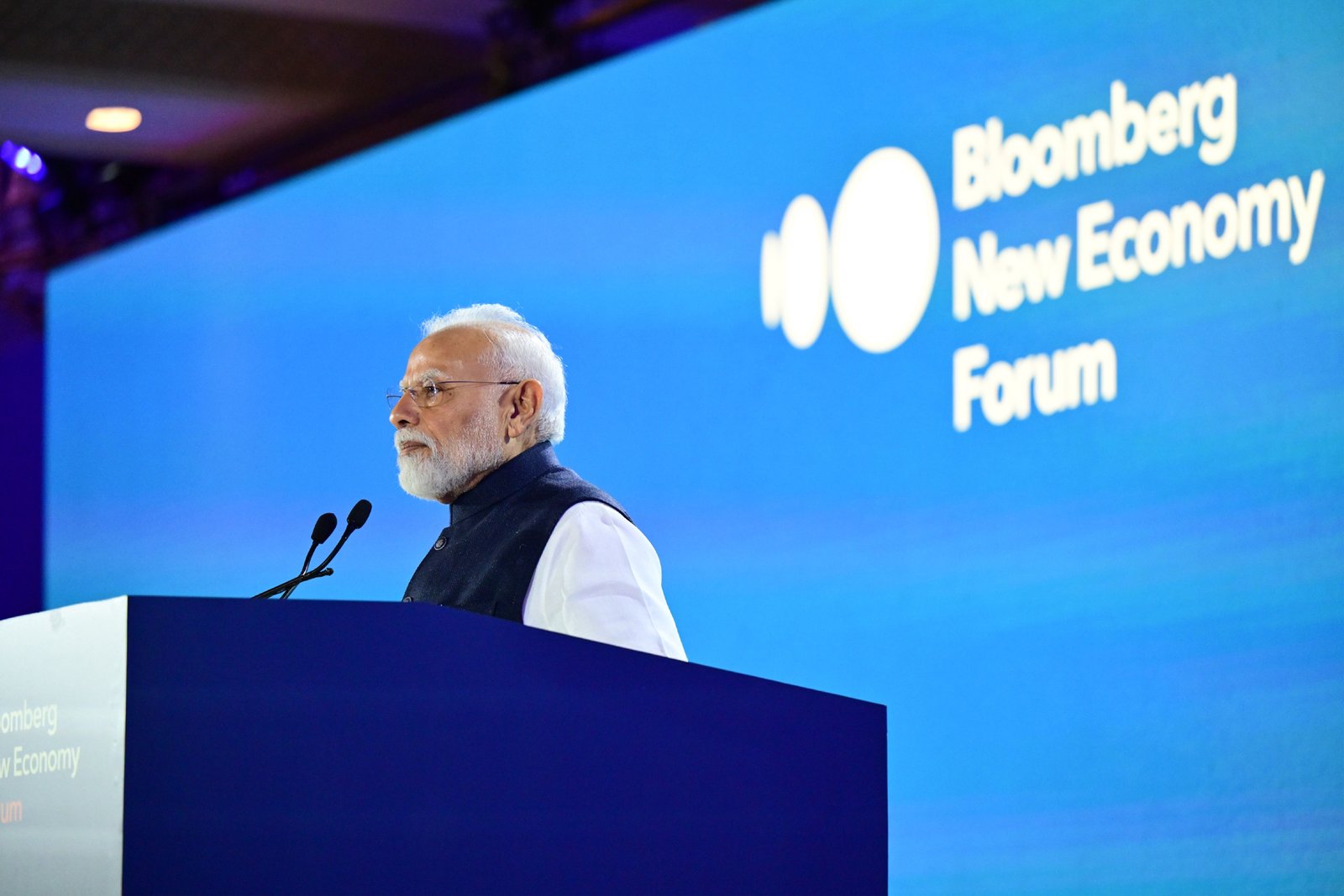
“I think I am significantly ahead in the queue from him. I applied five years back,” Mittal said at the Bloomberg New Economy Forum 2026.
OSLO, Oct 9,2026: South African judge Navanethem “Navi” Pillay, 85, won the Nobel Peace Prize on Friday “for her efforts to promote peace and international law”, the Norwegian Nobel Committee said.
Pillay held states and national leaders accountable and brought hope to victims of violence and conflict, and demonstrated a firm moral compass in her long career, the committee said.
“A common thread runs from her early work defending Nelson Mandela and others who stood up against apartheid to her service as a judge in some of the key international court cases of our time,” the committee said.
Navi Pillay was chair of the United Nations Commission of Inquiry on the Occupied Palestinian Territory that concluded last year that Israel has committed genocide in Gaza. Israel dismissed the report as “scandalous”.
The peace prize is the fifth Nobel awarded this week, after literature, chemistry, physics and medicine. Venezuelan opposition leader Maria Corina Machado won in 2025.
The Nobel Peace Prize, worth 12 million Swedish crowns, or about $1.2 million, is due to be presented in Oslo on December 10, the anniversary of the death of Swedish industrialist Alfred Nobel, who founded the awards in his 1895 will.
New Delhi, Oct 5,2026: The Supreme Court on Monday agreed to list a plea seeking directions to the Delhi Police to allow peaceful protests at Jantar Mantar in the national capital, amid ongoing demonstrations against Chief Election Commissioner Gyanesh Kumar.
The plea was mentioned before a bench headed by Chief Justice Surya Kant. Appearing for the petitioner, counsel submitted that the Delhi Police was not permitting peaceful protests in the city, including demonstrations by students, citizens, office-bearers of registered political parties and Members of Parliament.
The plea, filed amid protests against Chief Election Commissioner Gyanesh Kumar, seeks directions to the Delhi Police to permit peaceful demonstrations.
Chief Justice Surya Kant asked counsel to clarify the relief sought and whether the matter was a PIL. The CJI said the Court would check if similar pleas were pending and agreed to list the matter for consideration.
New Delhi, Oct 5,2026: The Election Commission of India on Monday sought to rebut what it described as a “misleading” claim over the Special Intensive Revision (SIR) of electoral rolls, asserting that the exercise was approved unanimously by the full Commission and that the Supreme Court had upheld the framework governing it.
In a “Fact Check” posted on social media platform X, the poll panel said its June 24, 2025 order directing the conduct of SIR across all States and union Territories, beginning with Bihar, was issued “with the unanimous approval of the Commission”. The ECI further said the order had subsequently been upheld by the Supreme Court in its judgment of May 27, 2026. The Commission also referred to Press Note No. 120 issued on September 26, 2026, particularly paragraph 1(iii), in support of its position on the declaration attached to Form 6 during the SIR exercise.
“The declaration attached to Form 6 for SIR has been upheld by the Hon’ble Supreme Court,” the ECI said, quoting its earlier press note. The clarification comes against the backdrop of an intensifying political and legal controversy over the conduct of SIR and the procedural requirements associated with Form 6, which is used for enrolment of new voters. Opposition parties have questioned the legal basis and manner in which certain changes or additional requirements were introduced, while the Commission has maintained that its decisions were taken collectively and in accordance with the law.
In its September 26 statement, the ECI had maintained that there was no change to the statutory Form 6 prescribed under the Registration of Electors Rules, 1960. It said the requirement introduced during SIR was an additional declaration and that the statutory forms prescribed under the 1960 Rules would continue to be used during periods when SIR was not in operation. The Supreme Court’s May 27 judgment examined legal challenges relating to the Bihar SIR and the process of electoral-roll revision.
The judgment recorded that the final electoral roll published in Bihar on September 30, 2025 contained 7.42 crore electors, compared with 7.89 crore electors on June 24, 2025, when the SIR exercise was ordered. The ECI’s latest intervention assumes significance as the controversy over Form 6 has continued despite its September clarification. The Commission has repeatedly maintained that the SIR decision was taken with the approval of all three Election Commissioners, even as Opposition leaders have questioned the validity of specific procedural changes and alleged that they were introduced without adequate statutory authority.
The issue also reached the Supreme Court on Monday, when the court declined to grant an interim order seeking the suspension of Chief Election Commissioner Gyanesh Kumar while issuing notice on a petition challenging decisions connected with the SIR exercise. The latest ECI fact check thus seeks to draw a distinction between the overarching decision to conduct SIR-which the Commission says received unanimous approval and was subsequently upheld by the Supreme Court-and the continuing dispute over the precise implementation of the additional Form 6 declaration.
The poll panel has reiterated that the SIR-related declaration has judicial backing, while the statutory forms prescribed under the 1960 Rules remain applicable outside the SIR process.
October 03, 2026: President Droupadi Murmu has given her assent to the Gujarat Uniform Civil Code (UCC) Bill, 2026, completing a key constitutional step towards its implementation. Gujarat has become the second state after Uttarakhand to secure approval for a Uniform Civil Code, which seeks to establish a common legal framework for personal matters across religious communities.
The legislation will come into force after the Gujarat government notifies the rules. Members of Scheduled Tribes (STs) are excluded from its provisions.
The Gujarat Assembly passed the Bill in March following a seven-and-a-half-hour discussion. Before the legislation was passed by voice vote, Congress legislators staged a walkout and demanded that the Speaker refer it to a Select Committee.
Chief Minister Bhupendra Patel said the legislation would promote equality and national integration. “The key aim of introducing the bill is to ensure social harmony and national unity. The Supreme Court has also suggested that UCC will ensure women’s rights are secured,” he said while introducing the Bill.
What does the Gujarat UCC provide?
The legislation establishes a common framework covering marriage, divorce, succession and inheritance, and live-in relationships, irrespective of religion.
It prescribes a minimum marriage age of 21 years for men and 18 years for women. Couples can solemnise marriages through religious ceremonies or under the Special Marriage Act, but registration is compulsory.
The Code prohibits a second marriage while an existing marriage remains valid, thereby disallowing polygamy. It also invalidates marriages between persons within prohibited degrees of relationship, unless an established custom or usage permits the union and is not contrary to public policy or morality.
The legislation further prohibits nikah halala, a practice requiring a divorced woman to marry another man and obtain a divorce before remarrying her former husband. It provides that divorced spouses can remarry without such a condition. Forcing or abetting the practice attracts legal consequences.
What are the rules for divorce and inheritance?
The Code establishes a common judicial procedure for divorce, replacing religion-specific methods of dissolving marriages, including customary out-of-court procedures and iddat-related processes.
Either spouse may seek divorce on grounds including adultery, cruelty, desertion for two continuous years, religious conversion and incurable unsoundness of mind. Wives have additional grounds where the husband is guilty of rape or an unnatural sexual offence, or has multiple wives from marriages contracted before the Code came into force.
Divorce by mutual consent is permitted if the couple has lived separately for at least one year.
For inheritance, the legislation introduces a common framework for intestate succession, applicable when a person dies without a will. The surviving spouse or spouses, surviving children, branches of predeceased children and surviving parents receive equal shares under the prescribed order of succession. Sons and daughters inherit equally, regardless of religion.
The Code does not alter testamentary succession, meaning property can still be distributed according to a valid will. If no eligible heirs survive, the estate passes to the government through Escheat.
How does the Code regulate live-in relationships?
Registration of live-in relationships is mandatory. Partners must submit a statement to the designated registrar, and couples must notify the authorities when their relationship ends.
A relationship cannot be registered if either partner is a minor, is already married, is in another live-in relationship or falls within a prohibited degree of relationship.
Failure to register a relationship after cohabiting for more than one month can attract imprisonment of up to three months, a fine of up to Rs 10,000, or both. The Bill also provides for a fine of up to Rs 10,000 for non-registration of marriages and divorces.
Children born from live-in relationships are recognised as legitimate children of the couple. Women deserted by their live-in partners can approach a competent court to seek maintenance.
What are the objections and constitutional concerns?
The Opposition criticised the legislation during its passage. Congress MLA Imran Khedawala described it as “against our society” and questioned its benefits, while alleging that the government should focus on other issues concerning Muslim women. AAP MLA Chatar Vasavane alleged that the Bill served electoral interests and raised concerns about its implications for tribal women marrying outside their communities.
Legal concerns also arise from compulsory registration and penalties for live-in relationships. A June 2026 analysis published by The Hindu noted that such provisions raise questions about individual autonomy and the State’s regulation of consensual adult relationships.
In S Khushboo v Kanniammal (2010), the Supreme Court held that morality and criminality are not synonymous and that live-in relationships and premarital sex should not be associated with criminality.
The analysis also cited Deepika Singh v Central Administrative Tribunal (2022), in which the Supreme Court recognised that non-traditional family structures deserve legal protection and social welfare benefits. Critics have been reported to argue that the UCCs do not adequately accommodate such family arrangements, including queer relationships.
Article 44 of the Constitution directs the State to endeavour to secure a Uniform Civil Code for citizens. Uttarakhand implemented its UCC in February 2024, while Gujarat’s law awaits notification of its implementation rules.
Gujarat is the second state after Uttarakhand became first in independent India to implement a Uniform Civil Code on January 27, 2025, introducing a common legal framework governing marriage, divorce, inheritance and live-in relationships, with an exemption for Scheduled Tribes.
New Delhi, September 30,2026: The Union Cabinet on Wednesday approved the Rs 1.86 lakh crore Green Energy Corridor Phase-III scheme to build transmission infrastructure for evacuation of up to 135 GW of renewable power and deploy 50 GWh of battery storage, as India prepares its grid for a sharp expansion in non-fossil energy capacity.Union Minister Ashwini Vaishnaw, announcing the decision after the Cabinet meeting, said adequate transmission capacity would be critical as renewable generation rises, with the government seeking to ensure that grid infrastructure comes up ahead of new renewable projects.A presentation made during the briefing said that without adequate transmission infrastructure, renewable power could face curtailment, and stressed that transmission capacity needed to precede renewable-energy capacity addition.
The scheme, targeted for completion by FY 2032-33, has a total project outlay of Rs 1,86,405 crore.Of this, Rs 1,36,378 crore will go towards strengthening intra-state transmission systems, while Rs 50,000 crore has been earmarked for deployment of 50 GWh of Battery Energy Storage Systems.The Centre will provide financial assistance of Rs 54,082 crore.The scale of the scheme reflects the growing challenge of integrating larger volumes of solar and wind power into the grid. Unlike conventional generation, renewable output varies with sunlight and wind conditions, requiring stronger transmission networks as well as storage to balance supply and demand.The battery systems can be installed at renewable-energy generation sites or other locations considered important for grid flexibility. According to the Cabinet release, they are intended to address intermittency, transmission congestion, peak-hour curtailment and demand during non-solar hours.The government said the corridor will enable evacuation of up to 135 GW of renewable power across states and Union Territories.Vaishnaw’s presentation said India is targeting 500 GW of non-fossil fuel capacity by 2030 and is planning for around 786 GW by 2035-36. The Cabinet release separately said the scheme would contribute towards the longer-term target of 900 GW of installed non-fossil capacity by 2035.India’s rapidly expanding solar capacity is already increasing the need for supporting grid infrastructure. According to an official PIB backgrounder, India’s installed solar capacity had reached 162.15 GW by June 30, 2026, up from around 3 GW in 2014. :chatgpt-content-reference{index=”0″}Under GEC-III, all new or greenfield intra-state transmission projects will be awarded through tariff-based competitive bidding.Transmission service providers selected through the bidding process will build, own, operate and maintain the assets, while State Transmission Utilities will act as the overall implementing agencies.Upgradation and strengthening of existing, or brownfield, transmission networks will be carried out on a cost-plus basis.The government said the central assistance would help offset intra-state transmission charges and limit their impact on electricity costs for consumers.The scheme also marks a significant expansion of India’s Green Energy Corridor programme, which was originally designed to strengthen transmission networks in states with high renewable-energy potential.With renewable generation expanding faster, the focus is increasingly shifting from merely creating generation capacity to ensuring that electricity can be transmitted, stored and supplied when it is needed.
Sept 29,2026: US and Iranian officials spoke separately with mediators on Monday as part of a renewed effort to end seven months of war, according to officials of both countries.
Any further talks are expected to focus on an amended version of a seven-day proposal that Iran presented last week on the sidelines of the United Nations General Assembly, an official briefed on the negotiations told Reuters.
The war began in late February with US and Israeli attacks on Iran, killing thousands of people over seven months and shocking global markets as vital waterways for oil remained choked. The US and Iran have twice previously agreed to ceasefires in mediated peace talks, in April and June. Those agreements quickly unraveled.
Iranian Foreign Minister Abbas Araqchi, who remained in New York after attending the General Assembly, said Iran expected to receive the US response to its latest ceasefire proposals and its conditions for restoring passage of maritime traffic in the Strait of Hormuz, according to state news agency IRNA.
“If the Americans claim they are seeking an agreement or a peaceful solution, we have presented that solution,” Araqchi said.
US officials separately spoke with mediators on Monday, US President Donald Trump told reporters at the White House, without giving further details.
Iran’s seven-day plan envisages an end to all hostilities in Iran and Lebanon, the unfreezing of billions of dollars’ worth of Iranian assets, an end to sanctions on Iranian oil and the lifting of the US blockade on Iranian ports.
Iran would then allow the reopening of the Strait of Hormuz, a vital conduit for oil tankers, and the two sides would also resume talks on Iran’s nuclear program and Trump’s wish to seize or eliminate its highly enriched uranium.
Trump said on Saturday he had rejected Iran’s proposal, saying Iran wanted a swift agreement because of the crippling economic pressure it is under. However, he also told Axios on Sunday that he expected US negotiators to engage in further talks this week.
Araqchi said on Sunday that mediators had not formally conveyed a US rejection, and that Iran was awaiting Washington’s definitive position before deciding its next steps.
Washington, Sept 29,2026: US Secretary of State Marco Rubio has suggested the possibility of jointly mining rare earth minerals in Greenland following the conclusion of a deal with local authorities.
On September 22, the US, Denmark, and Greenland signed an agreement to expand the American military presence on the island. “Sure, we will do it in partnership with them,” Rubio said in an interview with Fox News when asked if the US had a chance to engage in mining the rare earth elements with which the island is rich.
The Secretary of State emphasised that this had not been a US priority, but the opportunity arose after the deal with local authorities was finalised. “Now that this (deal) is behind us, I think we have the opportunity to make good investments there,” he concluded. Greenland possesses significant mineral reserves.
According to the Geological Survey of Denmark and Greenland (GEUS), 24 of the 34 raw materials classified by the European union as “critical” have been identified on the island. The exact volumes of many of the discovered resources have yet to be determined. However, the development of these deposits is complicated by natural conditions and a lack of infrastructure.
Patna, Sep 29,2026: The Patna High Court has held that pension benefits of a retired government employee cannot be withheld indefinitely through prolonged departmental proceedings and observed that pension constitutes a right to property protected under Article 300-A of the Constitution.
The ruling came in the case of retired Assistant Engineer Mahendra Ram of the Bihar Water Resources Department, whose retirement benefits remained partly withheld for years following disciplinary proceedings relating to an alleged illegal withdrawal of Rs 48,000. Justice Purnendu Singh, while hearing the matter, took serious note of the prolonged delay in concluding the departmental proceedings and observed that an unexplained and continuing delay in determining the retiral dues of a government employee can cause serious mental agony as well as financial hardship.
The court directed the State authorities to conclude the pending proceedings within six weeks. It further ordered that if the State failed to complete the proceedings within the stipulated period, the disciplinary proceedings would stand terminated, according to the order.
In such an eventuality, the authorities have been directed to release Ram’s pending retirement benefits, including his full pension, gratuity, and leave encashment, within a further period of two weeks. Ram had retired from government service in April 2020. Proceedings had been initiated against him in connection with the alleged withdrawal of Rs 48,000 from government funds.
According to the case put forward before the court, subsequent departmental inquiry did not establish that Ram had committed the alleged financial irregularity. The responsibility for the withdrawal was attributed to an Account Clerk, against whom disciplinary action was subsequently taken.
Despite the proceedings, Ram was granted only 90 per cent of a provisional pension, while the final determination of his retirement benefits remained pending. The court emphasised that a pension is not a bounty or a discretionary payment dependent solely on the will of the government, but a legally protected entitlement of a retired public servant.
The ruling also underscores the requirement for the State authorities to act within a reasonable and legally permissible period while dealing with disciplinary proceedings having a direct bearing on an employee’s retirement benefits.
WASHINGTON/UNITED NATIONS/DUBAI, Sept 27,2026: Iran insisted on Sunday that only diplomacy can solve its conflict with the United States and Israel, after US President Donald Trump said he rejected an Iranian proposal to reopen the Strait of Hormuz and end fighting.
“Our conditions are clear, and any move toward reopening the Strait of Hormuz is contingent on these conditions being met,” Iranian Foreign Minister Abbas Araqchi posted on social media. “Only a negotiated solution can get them out of this deadlock.”
Iran announced a peace proposal last week at the UN General Assembly in New York, saying it had been transmitted to the Americans via Qatari mediators. Trump said on Saturday he rejected the plan, and argued that desperation was driving the Iranians’ push for an agreement on the key waterway.
“They want to make a deal to open the Hormuz Strait immediately because they’re losing so badly,” Trump told reporters at the White House.
Keeping the door to diplomacy open, however, Trump told Axios in a phone interview on Sunday that he expected US negotiators to engage in more talks this week.
Araqchi said mediators facilitating Tehran’s talks with Washington had not officially relayed a US rejection of the plan.
“We are waiting for the mediators to convey the definitive views to us, and we will make a decision based on them,” Araqchi posted.
The US has imposed an economic blockade on Iran to put pressure on Tehran to stop Iranian attacks on vessels in the Strait of Hormuz, which have drastically reduced shipping through the area even as Trump repeatedly asserts that the US controls the waterway.
The commander-in-chief of Iran’s army, Amir Hatam, said the war was at a critical and decisive stage, adding that Tehran would not accept a situation in which it was unable to trade while foreign powers used the region’s strategic waterways.
“If Iran cannot trade, if Iran cannot live, no one will be able to trade or live,” he said, in comments reported by state media.
SAUDI ARABIA DRAWN DEEPER INTO WAR
Previous attempts at diplomacy have failed to end the war, which began on February 28 with US and Israeli strikes on Iran.
Since then it has alternated between pauses and renewed strikes, killing thousands while degrading the conventional forces of Iran and damaging its already ailing economy.
Iran and its allies have responded by extending the conflict throughout the region. Iran has struck US allies in the Gulf with drones and missiles, while its Houthi allies in Yemen have hit Saudi interests.
Saudi Arabia, the largest of the Gulf states, has been drawn deeper into the war this month as Houthi fighters have advanced in Yemen, routing forces of the Saudi-backed government and threatening Saudi oil exports through the Red Sea.
The Iran-backed Houthis have repeatedly fired into Saudi Arabia and, in a possible sign of further escalation, parents in Riyadh received notices from schools on Sunday saying classes would shift to remote learning for the week, according to people who received the messages.
The notice did not give a reason for the decision. Saudi authorities did not immediately respond to a request for comment.
Yemen’s Houthi-run health ministry, meanwhile, said seven people were killed and 40 wounded, including children, in a strike on shops at a market at the Mawiya junction in Taiz province, in the southwest.
Later, Yemen’s internationally recognised government said its forces had targeted a Houthi military camp and vehicles at the same junction.
CONFLICT HAS DISRUPTED OIL FLOWS, HARMED GLOBAL ECONOMY
The Iranians also engaged their Saudi rivals regarding the Strait of Hormuz during the brief flurry of diplomacy in New York, underscoring the stakes of a seven-month-old conflict that has disrupted oil flows through a critical shipping lane and taken a toll on the global economy.
Araqchi told reporters at the UN on Friday the proposed deal would trigger a seven-day countdown to reopening the strait and a pause in regional fighting.
“If there is seriousness on the US side to come to a deal and reopen the Strait of Hormuz, everything is now prepared,” Araqchi said. If the US were to agree, the warring parties could start wider talks “on mutually agreed subjects.”
That could potentially include discussions of Iran’s nuclear programme. Trump has cited preventing Tehran from ever acquiring a nuclear bomb as a key goal, along with ending its ability to attack its neighbours and creating conditions for Iranians to topple their leadership.
US envoy to the United Nations Mike Waltz said on Sunday in an interview with CNN’s State of the Union that Trump had rejected the Iranian proposal because it required the immediate lifting of sanctions and release of frozen assets.
September 15, 2026: U.S. Air Force Secretary Troy Meink on Monday revealed that the United States has deployed space-control weapons in orbit, while also disclosing new milestones for military satellite programs tied to missile defense and long-range targeting.
But it has not disclosed what those weapons are, how many exist, which satellites carry them, their orbits, or when they were launched.US Secretary of the Air Force Troy Meink said the “on orbit” weapon was necessary to safeguard US forces against hostile enemy action.
Speaking at the Air, Space and Cyber Conference on Monday, Meink said the US was ready for “evolving threats”, but did not elaborate on the weapon’s capabilities or when it was put into orbit.
Senior military leaders have previously said they planned to boost military capabilities in space, citing Russian and Chinese programmes developing ways to attack and disrupt US satellites in a future conflict.
China responded on Tuesday by warning against an “arms race” in space.
“We urge the US side to stop expanding its military capabilities and preparing for war in outer space,” AFP quoted a foreign ministry spokesman as saying.
Details of how the weapon operates have not been disclosed by US officials.
A US Space Force spokesperson said: “Space control encapsulates the mission areas required to contest and control the space domain – employing kinetic and non-kinetic means to affect adversary capabilities through disruption, degradation and even destruction, if necessary.
“These capabilities can be employed for offensive and defensive purposes at the direction of combatant commands.”
An expert on military uses of outer space noted that “precious little” was publicly known about the technology, and told the BBC there could be a “whole range of different weapons systems”.
Speaking to Radio 4’s Today programme, Dr Bleddyn Bowen, from the Royal United Services Institute (RUSI), said he was “totally guessing” but that the US could have been referring to “some kind electronic warfare or radio jamming platform”.
That would be the sort of weapon that already exists on Earth and could disrupt radio communications, Bowen said.
An alternative would be “a kinetic kill vehicle of some sort – so a vehicle that would release a projectile of some sort that would ram into a satellite and destroy it”.
But this was less likely because such a physically destructive tool would be capable of creating a lot of debris, Bowen added.
The Trump administration has said that space-based capabilities – and interceptor missiles – are a crucial part of its planned “Golden Dome” defence system to protect the US from missiles and other airborne threats.
Last year President Donald Trump issued an executive order underlining the US Space Force’s role in not only defending assets, but also as an attacking force.
The US Space Force – the first new branch of the US military for more than 70 years – was launched in 2019 as a way to protect American assets in space, including hundreds of satellites used for communication and surveillance.
A 1967 treaty banned weapons of mass destruction in orbit. Since then, key powers including the US, Russia, and China have been exploring other capabilities outside of the treaty, such as targeting rivals’ satellites – which are key for military communications, surveillance and navigation.
In early February, it was revealed that two Russian satellites had likely intercepted the communications of at least a dozen European ones since Russia’s invasion of Ukraine in 2022.
Such interceptions may have allowed Russian intelligence services to read the sensitive data they transmit, or hypothetically, even to take control of the satellites.
In 2024, the US said Russia had launched a satellite which it believed may be capable of attacking other such probes. Russia did not publicly comment on the issue.
The US Space Force says China “develops and operates space and counterspace capabilities as part of a military modernisation strategy,” while Russia “views space as a warfighting domain and believes space supremacy will be a decisive factor in future conflicts”.