Chennai, September 26,2026: Astronomers have confirmed the existence of a Jupiter-sized planet that is less than a million years old. Named Elias 2-24 b, it is the youngest known planet, offering scientists a rare opportunity to observe a world in the early stages of its formation.Its surprisingly rapid formation challenges leading theories about how giant planets come together, especially so far from their stars.Astronomers have confirmed the youngest known planet yet, a world less than 1 million years old that is still surrounded by the gas and dust from which it formed.According to the Science Daily website, the planet, called Elias 2-24 b, was identified using observations preserved in NASA-funded archives. It is still orbiting within its young star’s dusty disk, giving scientists a rare opportunity to study planet formation while it is still happening.”Our planet-formation models already struggled to explain the previous record holders for the youngest known planet — a four-way tie between two planets orbiting the star PDS 70 and two planets orbiting the star WISPIT 2 — which are all more than 5 million years old,” said Lucas Cieza, a professor at the Instituto de Estudios Astrofísicos in Chile and co-author of a paper detailing the results, as quoted by the website of Science Daily.”Elias 2-24 b shows us that even our best planet-formation models are still missing some important processes,” added Cieza. In a study published September 16 in The Astrophysical Journal Letters, researchers led by Andrea Bernardi, a doctoral candidate at the Universidad Diego Portales in Chile, examined archived observations of seven young stars.The stars were observed using the coronagraph at the W. M. Keck Observatory in Hawaii, which collaborates with NASA under a cooperative agreement. Surrounding each star is a debris disk containing dust, gas, and fragments of ice and rock. Gaps and other features within these disks may indicate that planets are in the process of forming.A coronagraph blocks much of a star’s bright light, making it easier to search for much fainter objects nearby. Using that technique, astronomers looked for planets hidden inside the dusty disks. Planets orbiting stars beyond our solar system are known as exoplanets.”The planets should be found within the gaps, since they are carving them,” Bernardi said. “And that’s exactly where we found Elias 2-24 b.”Elias 2-24 b is roughly as massive as Jupiter and orbits a star about 450 light-years from Earth. Because the system is so young, studying it gives astronomers a glimpse of what our own solar system may have looked like billions of years ago.Stars form inside vast clouds of gas and dust. Planets can then grow from material left over around the newborn star, gradually gathering matter and shaping paths through the surrounding disk.But observing planets during these earliest stages is extremely difficult because thick dust can hide them from view.
Most confirmed exoplanets have instead been found through transits. A transit occurs when a planet passes in front of its star and causes a small temporary drop in the starlight seen from Earth.That method becomes much harder to use when planets are still buried in dust or orbit very far from their stars.As a result, most of the roughly 6,000 confirmed exoplanets are billions of years old and orbit relatively close to their stars.Scientists currently build planet formation models using theories, computer simulations, and observations of young stars surrounded by disks where forming planets are often too difficult to detect directly. Discoveries such as Elias 2-24 b can provide crucial real-world tests for those models.”The galaxy churns out new stars and planets continuously, so there are many in every stage of evolution,” Cieza said. “That means we can see the entire process in theory, but there is a large gap in what most telescopes can detect. We are mostly blind to these baby planets right now.”A Decade-Old Mystery Comes Into FocusThe new confirmation also resolves a question astronomers have been debating for about 10 years.Earlier observations from ALMA (Atacama Large Millimeter/submillimeter Array) in Chile revealed a gap in the dusty disk surrounding the young star Elias 2-24. Later, the European Southern Observatory’s Very Large Telescope in Chile spotted a faint point of light inside that gap, according to the Science Daily website. Scientists wondered whether the object could be a planet. The problem was that existing planet formation theories suggested a large planet should not have been able to form so quickly, especially at such a great distance from its star.Current models suggest that forming a Jupiter-size planet at Jupiter’s distance from the Sun (which is just over five times larger than the distance of Earth to the Sun) takes about 5 million years. A giant planet much farther out should take even longer.Yet the faint object in the Elias 2-24 system sits about 55 times farther from its star than Earth is from the Sun and was already showing signs of being a forming planet.To investigate further, Bernardi and colleagues searched the Keck Observatory Archive, a NASA-funded collaboration between Keck Observatory and the NASA Exoplanet Science Institute at Caltech/IPAC.That analysis ultimately confirmed the object as Elias 2-24 b.”We usually hear about telescopes working separately, but this confirmation was possible only by using multiple telescopes together,” Bernardi said. “Elias 2-24 b is at the limit of what current telescopes can detect, but with new instruments like NASA’s Nancy Grace Roman Space Telescope, such detections should become easier.”They found the same faint object in observations collected in 2018 and 2020. By combining the observations and tracking how the object moved over time, the team determined that it behaved much more like a planet orbiting the star than an imaging artifact or a distant background star.
September 15, 2026: U.S. Air Force Secretary Troy Meink on Monday revealed that the United States has deployed space-control weapons in orbit, while also disclosing new milestones for military satellite programs tied to missile defense and long-range targeting.
But it has not disclosed what those weapons are, how many exist, which satellites carry them, their orbits, or when they were launched.US Secretary of the Air Force Troy Meink said the “on orbit” weapon was necessary to safeguard US forces against hostile enemy action.
Speaking at the Air, Space and Cyber Conference on Monday, Meink said the US was ready for “evolving threats”, but did not elaborate on the weapon’s capabilities or when it was put into orbit.
Senior military leaders have previously said they planned to boost military capabilities in space, citing Russian and Chinese programmes developing ways to attack and disrupt US satellites in a future conflict.
China responded on Tuesday by warning against an “arms race” in space.
“We urge the US side to stop expanding its military capabilities and preparing for war in outer space,” AFP quoted a foreign ministry spokesman as saying.
Details of how the weapon operates have not been disclosed by US officials.
A US Space Force spokesperson said: “Space control encapsulates the mission areas required to contest and control the space domain – employing kinetic and non-kinetic means to affect adversary capabilities through disruption, degradation and even destruction, if necessary.
“These capabilities can be employed for offensive and defensive purposes at the direction of combatant commands.”
An expert on military uses of outer space noted that “precious little” was publicly known about the technology, and told the BBC there could be a “whole range of different weapons systems”.
Speaking to Radio 4’s Today programme, Dr Bleddyn Bowen, from the Royal United Services Institute (RUSI), said he was “totally guessing” but that the US could have been referring to “some kind electronic warfare or radio jamming platform”.
That would be the sort of weapon that already exists on Earth and could disrupt radio communications, Bowen said.
An alternative would be “a kinetic kill vehicle of some sort – so a vehicle that would release a projectile of some sort that would ram into a satellite and destroy it”.
But this was less likely because such a physically destructive tool would be capable of creating a lot of debris, Bowen added.
The Trump administration has said that space-based capabilities – and interceptor missiles – are a crucial part of its planned “Golden Dome” defence system to protect the US from missiles and other airborne threats.
Last year President Donald Trump issued an executive order underlining the US Space Force’s role in not only defending assets, but also as an attacking force.
The US Space Force – the first new branch of the US military for more than 70 years – was launched in 2019 as a way to protect American assets in space, including hundreds of satellites used for communication and surveillance.
A 1967 treaty banned weapons of mass destruction in orbit. Since then, key powers including the US, Russia, and China have been exploring other capabilities outside of the treaty, such as targeting rivals’ satellites – which are key for military communications, surveillance and navigation.
In early February, it was revealed that two Russian satellites had likely intercepted the communications of at least a dozen European ones since Russia’s invasion of Ukraine in 2022.
Such interceptions may have allowed Russian intelligence services to read the sensitive data they transmit, or hypothetically, even to take control of the satellites.
In 2024, the US said Russia had launched a satellite which it believed may be capable of attacking other such probes. Russia did not publicly comment on the issue.
The US Space Force says China “develops and operates space and counterspace capabilities as part of a military modernisation strategy,” while Russia “views space as a warfighting domain and believes space supremacy will be a decisive factor in future conflicts”.
Bengaluru (Karnataka), September 9,2026: Group Captain and astronaut Angad Pratap on Wednesday said Gaganyaan will lay the foundation for India’s larger human spaceflight ambitions, including the Bharatiya Antariksha Station, stressing that the country’s ultimate aim should be to make space accessible to everyone and push the boundaries of knowledge for humanity.Speaking at the Space Expo session ‘The Next Chapter of Space: A Conversation on Exploration, Science and Innovation’, Pratap said Gaganyaan is about developing India’s independent capability to send humans into space and described it as a major technological milestone.“Gaganyaan is about acquiring the capability to launch a human to space domestically, here in India. It’s a huge capability, and I am very, very eagerly waiting for that day to happen. Because it is a very critical piece of what I would call apex technology, which has 16 to 20 very niche sets of technologies under it. So once you reach that milestone, it is a huge milestone for any country in the world, and we are going to be the fourth country in the world to do that, all by ourselves,” he said.
However, he said India’s human spaceflight ambitions should not be limited to Gaganyaan, pointing to the Bharatiya Antariksha Station as an important part of the country’s long-term plans.“Notwithstanding that, I wouldn’t really restrict myself to Gaganyaan, because in India people currently associate human spaceflight only with Gaganyaan. The Bharatiya Antariksha Station is still in the shadows. So Gaganyaan is nothing but human spaceflight,” Pratap said.He said human spaceflight would allow scientists to expand knowledge beyond what can be learnt by observing phenomena on Earth.“And for those from a physics background, you know about the physics cube. All of the learning we have had, whether in the biological domain or the engineering domain, we have learned primarily by observing things here on Earth. There is much, much more to learn out there, beyond Earth, for which you have to send your scientists. You have to send humans of all specialisations — who are probably sitting right here — all the way up there,” he added.Pratap said Gaganyaan should therefore be viewed as a foundation for much larger human spaceflight programmes. “So Gaganyaan may sound like just one single capability or a technology demonstrator where we just send one person, for one orbit maybe, and bring them back. But that will lay the foundation for much bigger things that I have already talked about, and Tom has already talked about,” he said.He also stressed the need for greater collaboration between the government and private sectors in India’s space programme.“We need to make space accessible to everyone. A lot of technology will cross over between the private sector and the government sector — it’s a symbiotic relationship, and both will gain from each other. But the ultimate aim is to push the boundaries of knowledge for humanity as a whole,” he added.
The session featured Sunita Williams, retired US Navy officer and NASA astronaut and Tom Shelley, Vice President, Crew Partnerships, VAST Space, who discussed the future of space exploration, science, innovation and commercial space stations.NASA astronaut Sunita Williams said India is “ready for the challenge” of building future space stations, while stressing that advanced technologies, autonomous systems and international cooperation will be critical as human spaceflight moves beyond the International Space Station (ISS).Williams said the next generation of space stations offers an opportunity to develop systems that can reduce dependence on Earth, including onboard databases, reliable 3D printing and autonomous scientific analysis. Reflecting on her experience aboard the ISS, Williams said astronauts cannot simply rely on a database or search engine in space in the same way people on Earth can.
New Delhi, August 21,2026: Prime Minister Narendra Modi on Friday urged India’s private space industry to explore wider applications of space technologies across sectors, saying the country can become a magnet for global talent, companies and investment in the space sector.He made the remarks while interacting with CEOs and founders of 20 space startups at Seva Teerth today, as he called for a greater collaboration between space companies and sectors such as agriculture and environmental protection.The Prime Minister has encouraged space companies to look beyond their existing applications and focus on how their technologies can improve people’s lives. He suggested that companies working on space debris could collaborate with environmental organisations, while those developing space technologies for agriculture could work with agricultural universities and departments to help farmers make better-informed decisions and improve output.
He also called for the creation of an ecosystem where, “when the world thinks of space, it looks towards India”, saying the country’s space sector can act as a magnet to attract global talent, companies and investment.The CEOs and founders highlighted the rapid progress of India’s private space industry and said companies across the world were showing growing interest in adopting and leveraging technologies developed by India’s emerging space sector.They also said the opening of the space sector to private participation had created new opportunities for industry and expressed appreciation for the support received from government.The startups represented diverse areas including rockets and reusable semi-cryogenic launch vehicles, avionics, satellites, advanced propulsion systems, space and defence intelligence, space debris removal and AI-powered hyperlocal weather and climate intelligence.
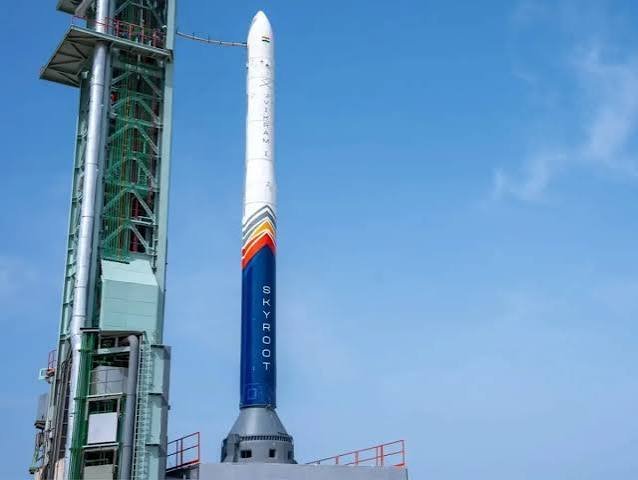
PM Modi congratulated the space-sector leaders for taking the lead in a new area, saying the confidence shown by the industry had strengthened the vision behind opening the sector to private participation.He noted that many countries either cannot invest in the space sector or do not wish to do so, presenting India with an opportunity to strengthen its position in the global space sector.The Prime Minister also called for closer collaboration between space companies and Atal Tinkering Labs to create curiosity and interest in space among young children from an early age.The interaction included CEOs and founders of Skyroot Aerospace, Agnikul Cosmos, Pixxel, Dhruva Space, GalaxEye, PierSight, Bellatrix Aerospace, Digantara, SatSure, Suhora Technologies, Manastu Space, Astrobase, TakeMe2Space, VyomIC, Cosmoserve Space, OrbitAID Aerospace, SkyServe, Serendipity Space, Vassar Labs and mistEO.
May 29,2026: An uncrewed Blue Origin New Glenn rocket exploded on a Florida launchpad during a test on Thursday, in a major setback for Jeff Bezos’ space venture as it seeks to narrow the gap with Elon Musk’s IPO-bound SpaceX.
Video posted by NASASpaceflight, which livestreams launches from Florida, showed the towering New Glenn rocket igniting on the pad at about 2100 ET (0100 GMT on Friday) before erupting into a massive fireball that billowed skyward, sending a towering plume of flames and smoke into the air.
Blue Origin was preparing the rocket for its fourth launch, which was due to deliver 48 Amazon Leo satellites into low-Earth orbit, part of efforts to build a broadband constellation to rival Musk’s Starlink network. Amazon Leo satellites were not integrated on the rocket at the time of the incident.
The explosion marks the latest setback for the long-delayed New Glenn, which is supposed to play a central role in delivering lunar landers and cargo under NASA’s Artemis lunar exploration missions.
It comes just two days after NASA awarded Blue Origin a $188 million contract to land rovers on the moon’s surface, and less than a week after SpaceX – years ahead in development – carried out a largely successful test of its next-generation Starship rocket.
Blue Origin confirmed it had experienced an “anomaly” during a hot-fire test, where a rocket engine is fired up while anchored to the ground.
CAPE CANAVERAL, Florida, April 1,2026: Four astronauts blasted off from Florida on Wednesday on NASA’s Artemis II mission, a high-stakes voyage around the moon that marks the United States’ boldest step yet toward returning humans to the lunar surface later this decade in a race with China.
NASA’s Space Launch System (SLS) rocket, topped with its Orion crew capsule, roared to life just before sunset at the agency’s Kennedy Space Center in Cape Canaveral, Florida, carrying its debut crew – three U.S. astronauts and a Canadian astronaut – into Earth orbit. The 32-story-tall space vehicle thundered into clear skies trailing a towering column of thick, white vapor.
NASA Administrator Jared Isaacman said the launch was an opening act for subsequent missions that would include construction of a moon base to support the “enduring presence we’re trying to create on the surface.”
If the mission proceeds as planned, the crew consisting of NASA astronauts Reid Wiseman, Victor Glover and Christina Koch, plus Canadian Space Agency astronaut Jeremy Hansen, will fly around the moon and back in their nearly 10-day expedition, putting the spacecraft through its paces while venturing deeper into space than humans have ever gone.
The mission is the debut crewed test flight in the Artemis program, successor to NASA’s Cold War-era Apollo project, and the world’s first to send astronauts in the vicinity of the moon, out of Earth’s orbit, in 53 years.
It serves as a crucial dress rehearsal for a NASA bid to land humans on the lunar surface later this decade, after one more crewed mission around the moon. NASA is targeting 2028 for Artemis IV, a first-ever landing of astronauts on the moon’s South Pole, seeking to beat China’s planned crewed mission to the same lunar region as early as 2030.
The last time astronauts walked on the moon – a feat so far achieved only by the United States – was the final Apollo mission in 1972.
‘FOR ALL HUMANITY’
After nearly three years of training, the crew is the first to fly in NASA’s Artemis program, a multibillion-dollar venture established in 2017 to build up a long-term U.S. presence on the moon over the next decade and beyond, serving as a stepping stone to eventual missions to Mars.
Minutes before liftoff, Canadian astronaut Hansen, strapped inside the gumdrop-shaped Orion capsule, told mission control in Houston: “This is Jeremy, we are going for all humanity.”
Sriharikota (Andhra Pradesh), Dec 24,2025: India’s heavy-lift rocket LVM3, also called ‘Bahubali’, successfully launched the US-based AST SpaceMobile’s advanced communication satellite BlueBird-6 into Low Earth Orbit (LEO) on Wednesday, precisely placing the American satelite and marking a major milestone in India’s commercial space capabilities.
The launch set a new record as the heaviest payload carried by an Indian rocket, with the mission focused on beaming broadband signals straight from space to everyday smartphones, eliminating the need for special devices.
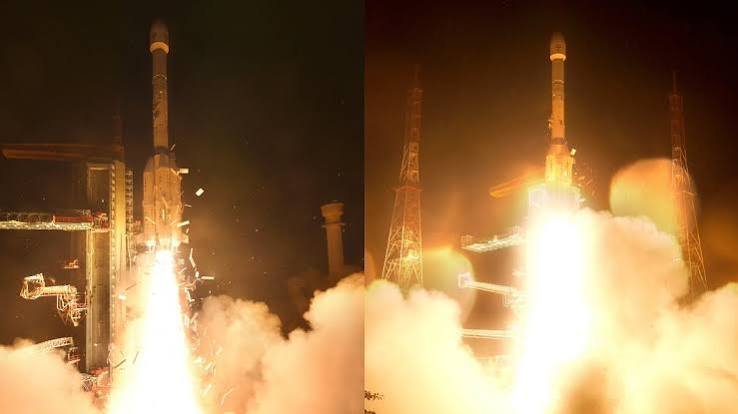
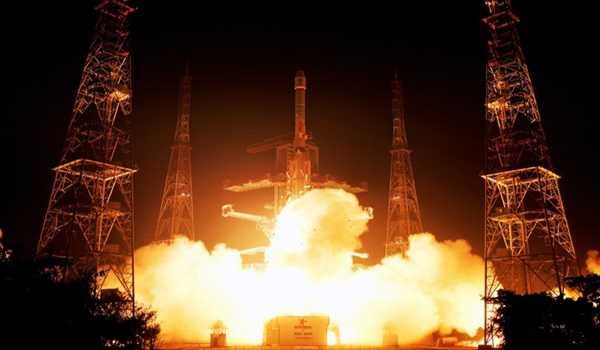
After a smooth 24-hour countdown, the 43.5-metre-tall, 640-tonne LVM3 rocket lifted off majestically from the Second Launch Pad at the Satish Dhawan Space Centre (SDSC) SHAR here at about 0855 hrs.
Prime Minister Narendra Modi hailed the successful launch, terming it a “proud milestone” in India’s space journey.
Addressing scientists from the Mission Control Centre, ISRO Chairman and Secretary, Department of Space, Dr V. Narayanan, announced that the US satellite had been successfully and precisely placed into its intended orbit. “This is a great achievement.
All the vehicle parameters performed normally. “This is the second LVM3 mission in a short span of 52 days,” he said, congratulating the entire ISRO team.
Narayanan added that this was the third commercial mission of LVM3 and the first involving a satellite from US-based AST SpaceMobile, thanking the company for reposing confidence in Indian launch capabilities.“We have lined up more launches in the coming days,” he said.
Scientists at the Mission Control Centre, including former ISRO chairmen, senior ISRO officials, and representatives from AST SpaceMobile, closely monitored the flight with bated breath as real-time data streamed in. LVM3-M6 marked the sixth operational flight of the LVM3 and maintained its impeccable record of ninth consecutive successful missions.
ISRO said the mission carried the heaviest payload ever launched from Indian soil into LEO, weighing 6,100 kg. “LVM3 is the operational heavy-lift launch vehicle. LVM3-M6 is its sixth operational flight and third dedicated commercial mission,” ISRO said.
The mission was undertaken as part of a commercial agreement between NewSpace India Limited (NSIL), the commercial arm of the Department of Space, and AST SpaceMobile LLC, USA. BlueBird-6 is part of AST SpaceMobile’s global LEO constellation designed to provide direct-to-mobile connectivity, enabling 4G and 5G voice and video calls, messaging, streaming, and data services anywhere in the world.
The satellite features a massive 223-square-metre phased array, making it the largest commercial communications satellite ever deployed into LEO.
AST SpaceMobile describes its network as the world’s first space-based cellular broadband system designed to connect directly with standard smartphones for both commercial and government users.
Founder, Chairman and CEO Abel Avellan had earlier said the next-generation satellites would enable ubiquitous cellular broadband from space. The company plans to deploy 45–60 satellites by the end of 2026.
LVM3, formerly known as GSLV Mk III, is nicknamed ‘Bahubali’, a name originally coined by Telugu media, drawing inspiration from the blockbuster film Bahubali, in which the hero effortlessly lifts a massive lingam, symbolising strength. On Wednesday, the nickname appeared to receive informal official recognition when Dr Narayanan referred to the vehicle as the “LVM3 Bahubali rocket” while announcing mission success.
The three-stage LVM3 consists of two S200 solid strap-on boosters, an L110 liquid core stage, and a C25 cryogenic upper stage. It can currently lift about 10 tonnes to LEO and 4 tonnes to GTO, with efforts underway to enhance its GTO capacity. With this mission, AST SpaceMobile becomes the second satellite broadband customer to fly on LVM3, after Eutelsat OneWeb, which launched 72 satellites using the vehicle in 2022 and 2023.
The successful BlueBird-6 launch further cements India’s position as a reliable global player in the commercial heavy-lift launch market.
Chennai, July 18,2025: The prestigious eagerly-awaited launch of NISAR mission, a Indo-US joint collaboration between NASA and ISRO, is likely to take place by the end of this month.
Both the space agencies have discussed about NISAR’s readiness for launch and potential opportunities for future cooperation including professional exchange in technical areas and space exploration.
NASA and ISRO are collaborating on one of NASA’s biggest project–the NASA-ISRO SAR Mission (NISAR), a joint Earth-observing mission.
NISAR will be launch from the Second Launch Pad from the Satish Dhawan Space Center, SHAR
Range in Sriharikota, into a near-polar orbit at an altitude of 747 km with an inclination of 98.4 deg.
ISRO will be using its heaviest home grown rocket GSLV-MkII/LMV for the mission.
Though sources said the mission is likely on July 30 or 31, the exact date was expected to be
announced on July 21.
The NISAR Mission will measure Earth’s changing ecosystems, dynamic surfaces and ice masses providing information about biomass, natural hazards, sea level rise and groundwater and will support a host of other applications.
NISAR will observe Earth’s land and ice-covered surfaces globally with 12-day regularity on ascending and descending passes, sampling Earth on average every 6 days for a baseline 3-year mission.
NISAR will map global land biomass, the amount of organic material from plants, every 12 days.