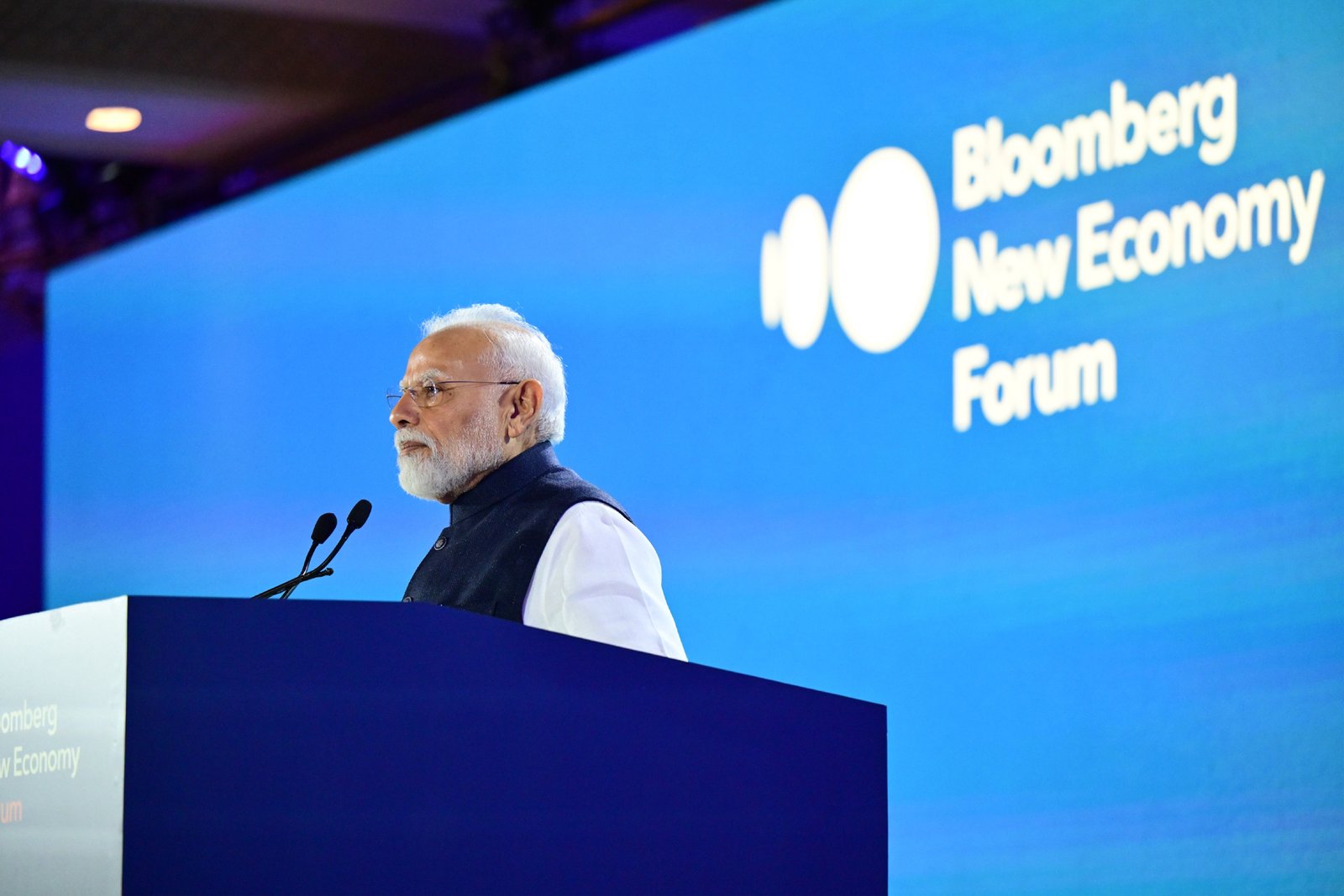
Modi’s address at the Bloomberg New Economy Forum in New Delhi
New Delhi,Oct 13,2026:
Friends,
This year’s Bloomberg Economic Forum is focused on the new powers emerging around the world. Every era has had its own sources of power and its own definition of power. But in the 21st century, especially in this third decade, a major transformation is taking place. Today, Technology is Power, Data is Power, Knowledge is Power, Innovation is Power.
But friends,
The real question is not who possesses power. Rather, the question is how that power is being used. Will technology advance only a few people? Or will it create new opportunities for millions? Will knowledge remain the strength of only a select few? Or will it enhance everyone’s capabilities? It is from here that a new idea emerges. And that idea is: Power to Empower. Power to Empower. Beyond Power to Control lies Power to Enable. Beyond Power to Compete lies Power to Collaborate. Beyond Power to Succeed lies Power to Help Others Succeed. And therefore, the vision with which I have come here today is: Power to Empower.
Friends,
This idea is not new to India. In our tradition, it is said: “Vidya Vivadaya Dhanam Madaya, Shaktih Paresham Paripidanaya; Khalasya Sadhoh Viparitam Etat, Jnanaya Danaya Cha Rakshanaya.” Its essence is that whoever possesses knowledge, wealth, or power, what matters is how they use it. In other words, the true value of power lies in its purpose. And it is very important to understand this philosophy in today’s world.
Friends,
This human spirit of Power to Empower is not merely a lesson meant to be preached to others. It is something that our traditions have taught us over thousands of years. And in India, we have demonstrated this by incorporating it into our governance and our work culture. Therefore, I will continue my remarks through examples from India itself.
Friends,
As all of you know, India is the Mother of Democracy. India has more than one hundred languages, nearly eighty thousand registered newspapers and publications, and more than one thousand satellite television channels. And not only that, in this age of social media, India has more than five hundred million YouTube users and more than five hundred million Instagram users. In our country, people openly debate different issues, and citizens discuss diverse viewpoints. In the present era, one factor that has played a major role in enabling this is digital power.
Friends,
Until about twelve or thirteen years ago, there was a time in India when access to mobile phones and the internet itself was a form of power. Whoever had access also had information, knowledge, and opportunities. After 2014, when a new government came to power in India and we were given the opportunity to serve, India placed great emphasis on making mobile data affordable. As a result, today a student in a small town can access digital learning. A small shopkeeper in a village can reach new customers. A young person can enroll in online courses. In other words, connectivity in India has not merely connected people; it has connected opportunities as well. This, indeed, is Power to Empower.
Friends,
To those guests who have come from abroad, I would encourage you to experience India’s digital payments ecosystem. In our country, a street vendor and a large car showroom may operate at completely different scales, but both use the same digital payments ecosystem. This is the strength of inclusive technology.
Friends,
Whatever capabilities India possesses, we do not believe in keeping them confined within our own borders. We continuously share them with the Global South and with our partner countries. We are sharing our experience in Digital Public Infrastructure with other nations so that they can develop digital systems according to their own needs. During the COVID period, we also developed the CoWIN platform, which was open source. In other words, our constant effort has been to ensure that India’s capabilities open new doors of possibility for other countries as well. In other words, our strength should empower humanity.
Friends,
The power of innovation works in the same way. Transforming an idea into a product, and turning a problem into a solution, is in itself a tremendous capability. But when such opportunities reach a larger number of people in society, the balance of power becomes more equitable and its impact multiplies many times over. India’s startup journey is an example of this transformation. Before 2014, India had only a few hundred startups. Today, the country has more than 250,000 startups. Nearly half of these startups come from small cities and towns. More than forty-five percent of startups have at least one woman Director or Partner. In other words, opportunities for innovation are reaching more people, new talent is emerging, and new solutions are being created.
Friends,
This focus on the purpose of power is equally important in governance. The government possesses authority, but its purpose should not be to make citizens dependent on the system. Rather, its objective should be to ensure that citizens become capable and empowered. India is moving along this very path. Following this path, India has lifted 250 million people out of poverty over the past decade, a number greater than the population of many countries in the world.
Friends,
You may also have heard about the JAM Trinity and Direct Benefit Transfer. By using technology, we have created a system through which government assistance reaches beneficiaries directly in their bank accounts. This has reduced corruption, increased convenience for citizens, and established a direct pathway between the government and the people.
Friends,
This same philosophy of Power to Empower is visible in India’s global engagement. During the COVID pandemic, vaccine manufacturing capacity became extremely important. The question at that time was whether the benefits of this capability would remain limited to only a few countries, or whether vaccines would also reach those nations and people who lacked such facilities and capabilities. India chose the path of empowering humanity. We supplied vaccines to more than one hundred countries. Our manufacturing capability became a source of assistance for other nations as well. Let me give you another interesting example. A few months ago, India hosted the AI Impact Summit, and Mr. Bloomberg has just spoken very highly of that summit. There, we discussed not only the use of AI for humanity, but also how animals could benefit from AI. Nandan, who is seated here, can later share much more information about how this was done. In other words, the more capable and stronger India becomes, the more beneficial it will be for humanity and for the world.
Friends,
Power is not just the ability to move ahead. It is also the ability to empower others to move ahead. India believes that competition is important, but compassion is equally important. Innovation is essential, but its benefits must also be widely shared. National strength is necessary, but we must also contribute solutions to global challenges. Whether it is climate change, water governance, public health, or the responsible use of emerging technologies, the world needs capabilities that provide solutions and create new opportunities.
Friends,
Let me give you another example. Under the Paris Agreement, India made a major commitment to address climate change. In 2015, we set ourselves the target of achieving 40 percent of our installed electricity capacity from non-fossil fuel sources by 2030. India achieved this milestone in November 2021 itself, nine years ahead of schedule. India became the first G20 nation to do so. This was not merely about fulfilling a commitment; it was also a reflection of India’s evolving energy journey.
Friends,
In 2014, India’s renewable energy capacity stood at about 75 gigawatts. Today, it has reached approximately 300 gigawatts. In other words, we have added nearly four times more capacity.
Friends,
This energy transition underway in India is also creating new opportunities. Today, we have schemes such as PM Surya Ghar and PM-KUSUM. One scheme is connecting households to solar power, while the other is enabling farmers to generate solar energy and reduce their input costs through its use. Through these two schemes, India has achieved more than 30 gigawatts of solar capacity. It is estimated that they will reduce carbon emissions by more than 30 million tonnes annually. In other words, solar power is not only becoming a means of protecting nature, but also a means of empowering people.
Friends,
In this global race for power, India is moving forward with a different mindset. And this decade itself bears witness to that.
Friends,
This decade of the twenty-first century has brought unprecedented global challenges. If we look back at the last six years, we witnessed a global pandemic. Then wars broke out in different regions. As if that were not enough, disruptions emerged in trade, critical minerals, and energy supplies. The world begins to find a way out of one crisis when another crisis appears. Things that once connected the world are now being turned into weapons. Supply chains, energy, minerals, payment systems, and technology are increasingly becoming instruments of pressure and dominance. The routes created by globalization over past decades have, in many cases, become chokepoints. Amid all this, Artificial Intelligence is transforming the way every sector functions. At the same time, many countries are facing rapidly growing challenges related to ageing populations. In such circumstances, the world is confronted with a fundamental question: trust. Trust that supplies will continue during times of need. Trust that promises made will also be fulfilled. Trust that a partner country will stand by you during moments of crisis. And it is here that India stands before you with a different outlook and a different way of thinking.
Friends,
India’s progress in the twenty-first century is a story of advancing together with everyone and carrying everyone along. When the world needs affordable medicines, one out of every five generic medicines comes from India. When solutions for digital identity and payments are required, the world looks to models developed in India. When the world needs talent, it places its trust in India’s skilled youth. Today, India is home to more than 2,000 Global Capability Centres that are providing services to companies across the world.
Friends,
It is clear that whenever the world needs a steady pillar, India extends its hand in support, recognizing its responsibility. We do not grow at anyone’s cost. We grow with the world, and for the world.
And friends,
India does not seek credit for what it does. The world proudly says that India gave Zero to the world. This Zero benefited all of humanity. Yet India never asked for royalties in return. Even today, India works with the same spirit. The ideas we offer for addressing contemporary challenges also reflect this outlook. Throughout history, many global organizations have been created, each serving its own interests. But consider the kind of global platforms India has created. Consider the institutions we have established and compare them with what has emerged elsewhere in the world. What have we contributed? The International Solar Alliance. What have we contributed? The Coalition for Disaster Resilient Infrastructure. What have we contributed? The Big Cat Alliance, the Global Biofuel Alliance, the India-Middle East-Europe Economic Corridor (IMEC), and Mission LiFE, Lifestyle for Environment. These are initiatives that benefit everyone and contribute to the well-being of all life.
Friends,
The ideas that India has brought forward are before you. The vision of One Sun, One World, One Grid. The belief in One Earth, One Family, One Future. The vision of One Earth, One Health. In other words, India places emphasis on connecting and coming together. And even in this, power is used to empower others.
Friends,
In a world filled with uncertainty, India offers the assurance of reliability and stability. In the April-June quarter of this year, India’s growth rate stood at 7.8 percent. And this growth rests on a strong foundation. Twelve to thirteen years ago, India’s current account deficit was more than four percent of GDP. Last year, it declined to approximately half a percent, standing at 0.61 percent. Today, our foreign exchange reserves exceed 700 billion dollars. Our banking system is in its strongest position in many decades.
Friends,
It is because of this strength that India’s sovereign ratings are being upgraded. Today, India’s confidence is at an unprecedented high. We are pursuing reforms with a clear policy direction. Through GST, we transformed a complex web of taxes into a national market. We enacted the Insolvency Law. Twenty-nine labour laws have now been consolidated into four simple labour codes. Hundreds of minor business-related offences have been decriminalized. And we have not stopped there. India’s reform express continues to move ahead at high speed. For us, reforms are not a compulsion. Reforms are our conviction.
Friends,
Thousands of years ago, our Vedas gave us a mantra: “Sangachchhadhwam Samvadadhwam Sam Vo Manamsi Janatam. Let us repeat that mantra today: Let us walk together. Let us speak together. Let us strive to understand one another. Because when we walk together, our strength grows. Through dialogue, our understanding deepens. And by understanding one another, we can jointly solve great challenges. This is the essence of Power to Empower. It means not limiting our power solely to our own progress, but using it to create new opportunities for others as well. I am confident that this very platform of the Bloomberg Economic Forum will become a major platform for advancing this spirit. Once again, my very best wishes to all the participants for this event. Thank you very much. Thank you.