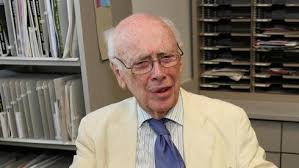
Nov 8,2025: James D. Watson, the brilliant but controversial American biologist whose 1953 discovery of the structure of DNA, the molecule of heredity, ushered in the age of genetics and provided the foundation for the biotechnology revolution of the late 20th century, has died at the age of 97.
In his later years, Watson’s reputation was tarnished by comments on genetics and race that led him to be ostracized by the scientific establishment.
Even as a younger man, he was known as much for his writing and for his enfant-terrible persona – including his willingness to use another scientist’s data to advance his own career – as for his science.
His 1968 memoir, “The Double Helix,” was a racy, take-no-prisoners account of how he and British physicist Francis Crick were first to determine the three-dimensional shape of DNA. The achievement won the duo a share of the 1962 Nobel Prize in medicine and eventually would lead to genetic engineering, gene therapy and other DNA-based medicine and technology.
Crick complained that the book “grossly invaded my privacy” and another colleague, Maurice Wilkins, objected to what he called a “distorted and unfavorable image of scientists” as ambitious schemers willing to deceive colleagues and competitors in order to make a discovery.
In addition, Watson and Crick, who did their research at Cambridge University in England, were widely criticized for using raw data collected by X-ray crystallographer Rosalind Franklin to construct their model of DNA – as two intertwined staircases – without fully acknowledging her contribution. As Watson put it in “Double Helix,” scientific research feels “the contradictory pulls of ambition and the sense of fair play.”
In 2007, Watson again caused widespread anger when he told the Times of London that he believed testing indicated the intelligence of Africans was “not really … the same as ours.”
Accused of promoting long-discredited racist theories, he was shortly afterwards forced to retire from his post as chancellor of New York’s Cold Spring Harbor Laboratory (CSHL). Although he later apologized, he made similar comments in a 2019 documentary, calling different racial attainment on IQ tests – attributed by most scientists to environmental factors – “genetic.”
‘TOUGH IRISHMAN’
James Dewey Watson was born in Chicago on April 6, 1928, and graduated from the University of Chicago in 1947 with a zoology degree. He received his doctorate from Indiana University, where he focused on genetics. In 1951, he joined Cambridge’s Cavendish Lab, where he met Crick and began the quest for the structural chemistry of DNA.
Just waiting to be found, the double helix opened the doors to the genetics revolution. In the structure Crick and Watson proposed, the steps of the winding staircase were made of pairs of chemicals called nucleotides or bases. As they noted at the end of their 1953 paper, “It has not escaped our notice that the specific pairing we have postulated immediately suggests a possible copying mechanism for the genetic material.”
That sentence, often called the greatest understatement in the history of biology, meant that the base-and-helix structure provided the mechanism by which genetic information can be precisely copied from one generation to the next. That understanding led to the discovery of genetic engineering and numerous other DNA techniques.
Watson and Crick went their separate ways after their DNA research. Watson was only 25 years old then and while he never made another scientific discovery approaching the significance of the double helix, he remained a scientific force.
“He had to figure out what to do with his life after achieving what he did at such a young age,” biologist Mark Ptashne, who met Watson in the 1960s and remained a friend, told Reuters in a 2012 interview. “He figured out how to do things that played to his strength.”
That strength was playing “the tough Irishman,” as Ptashne put it, to become one of the leaders of the U.S. leap to the forefront of molecular biology. Watson joined the biology department at Harvard University in 1956.
“The existing biology department felt that molecular biology was just a flash in the pan,” Harvard biochemist Guido Guidotti related. But when Watson arrived, Guidotti said he immediately told everyone in the biology department – scientists whose research focused on whole organisms and populations, not cells and molecules – “that they were wasting their time and should retire.”
That earned Watson the decades-long enmity of some of those traditional biologists, but he also attracted young scientists and graduate students who went on to forge the genetics revolution.
In 1968 Watson took his institution-building drive to CSHL on Long Island, splitting his time between CSHL and Harvard for eight years. The lab at the time was “just a mosquito-infested backwater,” said Ptashne. As director, “Jim turned it into a vibrant, world-class institution.”
GENOME PROJECT
In 1990, Watson was named to lead the Human Genome Project, whose goal was to determine the order of the 3 billion chemical units that constitute humans’ full complement of DNA. When the National Institutes of Health, which funded the project, decided to seek patents on some DNA sequences, Watson attacked the NIH director and resigned, arguing that genome knowledge should remain in the public domain.
In 2007 he became the second person in the world to have his full genome sequenced. He made the sequence publicly available, arguing that concerns about “genetic privacy” were overwrought but made an exception by saying he did not want to know if he had a gene associated with an increased risk of Alzheimer’s disease. Watson did have a gene associated with novelty-seeking.
His proudest accomplishment, Watson told an interviewer for Discover magazine in 2003, was not discovering the double helix – which “was going to be found in the next year or two” anyway – but his books.
“My heroes were never scientists,” he said. “They were Graham Greene and Christopher Isherwood – you know, good writers.”
Watson cherished the bad-boy image he presented to the world in “Double Helix,” friends said, and he emphasized it in his 2007 book, “Avoid Boring People.”
Married with two sons, he often disparaged women in public statements and boasted of chasing what he called “popsies.” But he personally encouraged many female scientists, including biologist Nancy Hopkins of the Massachusetts Institute of Technology.
“I certainly couldn’t have had a career in science without his support, I believe,” said Hopkins, long outspoken about anti-woman bias in science. “Jim was hugely supportive of me and other women. It’s an odd thing to understand.”