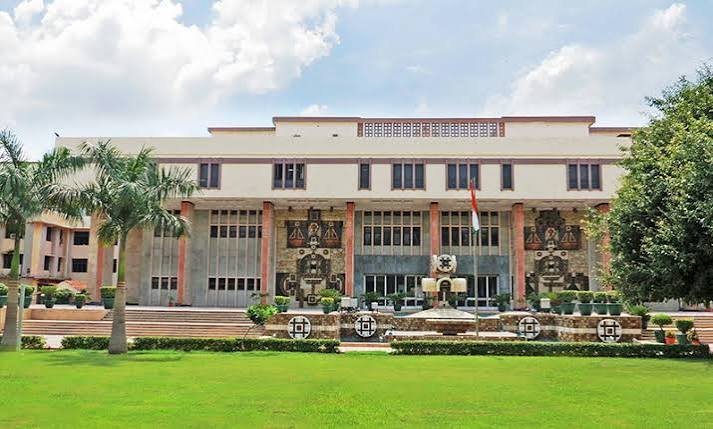
New Delhi, Nov 8,2024: The Supreme Court 7-judge bench by a 4-3 majority verdict laid down indicia for determining whether an educational institution is a minority institution but did not answer whether Aligarh Muslim University is a minority educational institution.
The Apex Court overruled 1967 judgement in Azeez Basha case.
The Court overruled Basha judgment which said an educational institution can claim ‘minority tag’ only if established and managed by a minority community.
The Top Court said a regular bench will decide whether AMU is a minority institution based on the indicia laid down by the 7-Judge bench.
The seven-judge Bench however, has laid down guidelines for determining whether an educational institution is a minority institution.
The seven-judge bench has now sent the question of whether AMU is a minority institution to a three-judge bench.
It means the Allahabad High Court’s 2005 judgment which quashed the AMU’s minority status and the undertaking given by the AMU in the SC that it would not give 50% religious quota stands as of now.
Justice Chandrachud informed that there are 4 opinions in the case.
The majority opinion was by CJI, for himself and Justices Sanjiv Khanna, J B Pardiwala and Manoj Misra.
Separate dissenting opinions were rendered by Justices Surya Kant, Dipankar Datta and S C Sharma.
Justice Surya Kant said the five-judge bench of SC in Aziz Basha case had correctly decided that AMU was not a minority institution, which has attained finality, and that there is no need to reopen the inquiry into the character of AMU.
Justice Kant strongly criticised the manner in which the case was referred by a 3-Judge bench to the present 7-Judge bench and termed it as a judicial impropriety on the part of the smaller bench and also on the part of the then CJI in accepting the request.
Justice S C Sharma said his opinion is neither concurring nor dissenting with the majority opinion authored by CJI Chandrachud. However, he agreed with dissents that the 3-Judge bench could not have referred the case directly to a 7-Judge bench.
In the case relating to the minority status of Aligarh Muslim University (AMU), a 7-judge bench of the Supreme Court (by 4:3 majority), overruled the 1967 judgment in S. Azeez Basha vs. Union Of India to the extent it held that an institution incorporated by a statute cannot claim to be a minority institution.
The issue whether Aligarh Muslim University is a minority institution as per Article 30 of the Constitution is now left to be decided by a regular bench based on this view of the majority.
In Azeez Basha, the Court had ruled that AMU cannot claim minority status as it was established by a statute. Today, the majority led by Chief Justice of India DY Chandrachud overruled Azeez Basha and held that an institution will not lose its minority status merely because it was created by a statute. The majority held that the Court must examine who established the University and who was the “brain” behind it. If that enquiry is pointing towards a minority community, then the institution can claim minority status as per Article 30. For this factual determination, the Constitution Bench relegated the matter to a regular bench.
“The view taken in Azeez Basha that an educational institution is not established by a minority if it derives its legal character through a statute is overruled,” the majority stated.
Chief Justice of India DY Chandrachud, on his last working day, pronounced the judgment on behalf of the majority (comprising himself, Justices Sanjiv Khanna, JB Pardiwala and Manoj Misra)
Justices Surya Kant partially dissented from the majority on certain aspects, however agreed that Azeez Basha view required to be modified and clarified to a certain extent. Justices Dipankar Datta and SC Sharma dissented.
The Constitution Bench comprising Chief Justice of India DY Chandrachud, Justices Sanjiv Khanna, Surya Kant, JB Pardiwala, Dipankar Datta, Manoj Misra and SC Sharma was hearing a reference arising out of the 2006 verdict of the Allahabad High Court which held that AMU was not a minority institution. The bench heard the matter 8 days before reserving it on February 1.
The key issue of reference for deliberation was : “What are the indicia for treating an educational institution as a minority educational institution? Would an institution be regarded as a minority educational institution because it was established by a person(s) belonging to a religious or linguistic minority or its being administered by a person(s) belonging to a religious or linguistic minority?”
The 4 main aspects for consideration before the bench were : (1) whether a University, established and governed by a statute (AMU Act 1920), can claim minority status; (2) The correctness of the 1967 judgment of the Supreme Court in S. Azeez Basha vs. Union Of India (5-judge bench) which rejected the minority status of AMU ; (3) the nature and correctness of the 1981 amendment to the AMU Act, which accorded minority status to the University after the decision in Basha; (4) Whether reliance placed on the Basha decision by Allahabad High Court in AMU v. Malay Shukla in 2006 was correct in concluding that AMU being a non-minority institution could not reserve 50% seats for Muslim candidates in Medical PG Courses.
A detailed explainer on the issue of AMU’s plea for the grant of minority status and arguments raised by the parties can be read here.
Highlights from the judgment
Majority view
Article 30 will stand diluted if it is to apply prospectively only to the institutions which were established after the commencement of the Constitution.
The words ‘incorporation’ and ‘establishment’ cannot be used interchangeably. Merely because the AMU was incorporated by an imperial legislation would not mean that it was not ‘established’ by a minority. It cannot be argued that the University was established by the Parliament merely because the statute says it was passed to establish the University. Such a formalistic reading will defeat the objectives of Article 30. Formalism must give way to actuality. To determine who established the institution, the Court must trace the genesis of the institution and identify who was the “brain” behind it. The proof of ideation must point towards a member of the minority community. It has to be seen who got funds for the land and if the minority community helped.
It is not necessary that the institution was established only for the benefit of the minority community but must be predominantly for its benefit.
An educational institution is a minority educational institution if it is established by a religious or linguistic minority : Majority view
The CJI’s judgment stated :
“We have already held above that an educational institution is a minority educational institution if it is established by a religious or linguistic minority. We have clarified that it is not necessary to prove that administration vests with the minority to prove that it is a minority educational institution because the very purpose of Article 30(1) is to grant special rights on administration as a consequence of establishment. To do otherwise, would amount to converting the consequence to a pre-condition. The right to administer is guaranteed to minority educational institutions to enable them to possess sufficient autonomy to model the educational institution according to the educational values that the community wishes to emphasise. It is not necessary that the purpose can only be implemented if persons belonging to the community helm the administrative affairs. This is so particularly because a minority institution may wish to emphasise secular education. The founders or the minority community may choose to populate the managing board (or a comparable authority) responsible for the day-to-day administration of the institution with persons belonging to the same community. However, they are not compelled to do so. They may wish to appoint persons who do not belong to their community but who they deem fit for the proper administration of the institution.”
The test to be adopted by the Court is whether the administrative set up of the educational institution affirms the minority character of the institution. If the administrative structure of the educational institution does not reflect its minority character or when it does not elucidate that the educational institution was established to protect and promote the interests of the minority, it may be reasonably inferred that the purpose was not to establish an educational institution for the benefit of the minority community”
The decision in Azeez Basha is overruled and the question of deciding the minority status of AMU must be done on the basis of the tests laid down in the present case. The papers of the batch of cases are to be placed before a regular bench to decide the issue and correctness of the 2006 Allahabad HC.
Justice Surya Kant’s view
Justice Surya Kant took objection to the reference order passed in Anjuman in 1981 directly referring the matter to a 7-judge bench. However, the 2019 reference made by a bench led by the then CJI is maintainable.
Justice Kant also agreed that Azeez Basha view required to be corrected :
“Azeez Basha (supra) however, seems to be erroneous to the extent it holds that since Section 6 of the Aligarh Muslim University Act, 1920 (AMU Act, 1920) provided that the degrees conferred by the university would be recognised by government, consequently, “an institution was brought into existence which could not be brought into existence by a private individual or body…” Azeez Basha (supra) might therefore not be correct in its entirety and as a general principle of law, to hold that even if the AMU Act, 1920 was passed as a result of the efforts of the Muslim minority it “does not mean that the Aligarh University when it came into being under the 1920 Act was established by the Muslim minority”.”
“In this context, it is our considered opinion that the establishment of a university, whether as a minority institution or as a religion neutral institution of high standard, is a complex and mixed question of law and fact. The legislative intent behind the establishment of a university or an institution will have a significant role in determining the status of such an institution. For instance, if the Preamble or the Statement of Objects and Reasons of a Statute explicitly states that the University or the institution concerned is intended to be established and shall be administered by a minority community, we see no reason as to why such a University or institution would be denuded of its minority character merely because it was created through legislative means.
Conversely, if the Legislature by itself (particularly, post- Constitution) decides to establish an institution where besides preserving the culture, values, traditions, language and conventions of a religious or linguistic minority community, it promotes other streams of education without any barrier to children belonging to other religions, it will be highly debatable to discern whether such a university can take refuge under the protective umbrella of Article 30.”
Justice Kant however did not overrule Azeez Basha and said that it required only to be modified and clarified to the above extent.
Educational institutions under Article 30(1) also include universities. Minority institutions, to get Article 30 protection, must satisfy the conjunctive tests of “established” and “administered” by a minority.
The legislative intent behind a statute incorporating a university or institution would be necessary to decide its minority status.
Whether AMU is a minority institution is a mixed question of law and fact, which is to be decided by a regular bench.
Justice Dipankar Datta
Justice Datta made a categorical declaration that AMU is not a minority institution. He also held that the references, both in 1981 and 2019, were unnecessary.
Justice SC Sharma
The minority community should be controlling the administration of the institution without any help of outside forces. The minority institution must also give the option of secular education.
‘Established’ and ‘administered’ words have to be used conjunctively. It cannot be conflated with situations such as genesis or founding moments. To claim establishment, they have to bring it to existence, they should play full role to the exclusion of others.The authority to hire and fire staff should be with the minority and functional and authoritative control should be with the minority.
The crux of Article 30 is to prevent any preferential treatment for minorities and thus give equal treatment for all. To assume that minorities of the country require a safe haven to pursue education is incorrect. Minorities are very much a part of the mainstream now partaking in equal opportunities.
Case Reference Trajectory
The 7-judge bench was formed as a consequence of a reference order of 2019 passed by a 3-judge bench headed by the then CJI Ranjan Gogoi. The reference occurred while hearing an appeal against the 2006 Allahabad High Court’s Judgement.
One can say that the matter has been re-referred. Considering the Apex Court’s past two attempts at deliberating upon the issue. Between the 1967 Supreme Court ruling and the 2006 Allahabad High Court judgment, there is a Supreme Court directive from 1981 (in Anjuman-e-Rahmania Vs. District Inspector of School), where the matter addressed in the Basha Judgment was forwarded to a Seven Judges Bench. The referred question was as follows :
“What are the indicia for treating an educational institution as a minority educational institution? Would an institution be regarded as a minority educational institution because it was established by a person(s) belonging to a religious or linguistic minority or its being administered by a person(s) belonging to a religious or linguistic minority?”
While the mentioned reference was considered by an 11-judge bench along with T.M.A. Pai Foundation vs. State of Karnataka, the Bench opted not to address the question, stating that it would be handled by the Regular Bench. Subsequently, the regular bench also refrained from providing an answer to the said question.
Representing AMU and the AMU Old Boys’ Association, were Senior Advocates Dr Rajeev Dhavan and Mr Kapil Sibal along with Mr Salman Khurshid, Mr Shadan Farasat who appeared on behalf of intervenors.
The Union of India was represented by the Attorney General Mr R Venkataramani as well as the Solicitor General Mr Tushar Mehta. Several other senior advocates including Mr Neeraj Kishan Kaul, Mr. Guru Krishna Kumar, Mr Vinay Navare, Mr. Yatinder Singh, Mr. Vikramjit Banerjee (ASG) and Mr KM Nataraj (ASG) also appeared to advance arguments on behalf of respondents and intervenors.