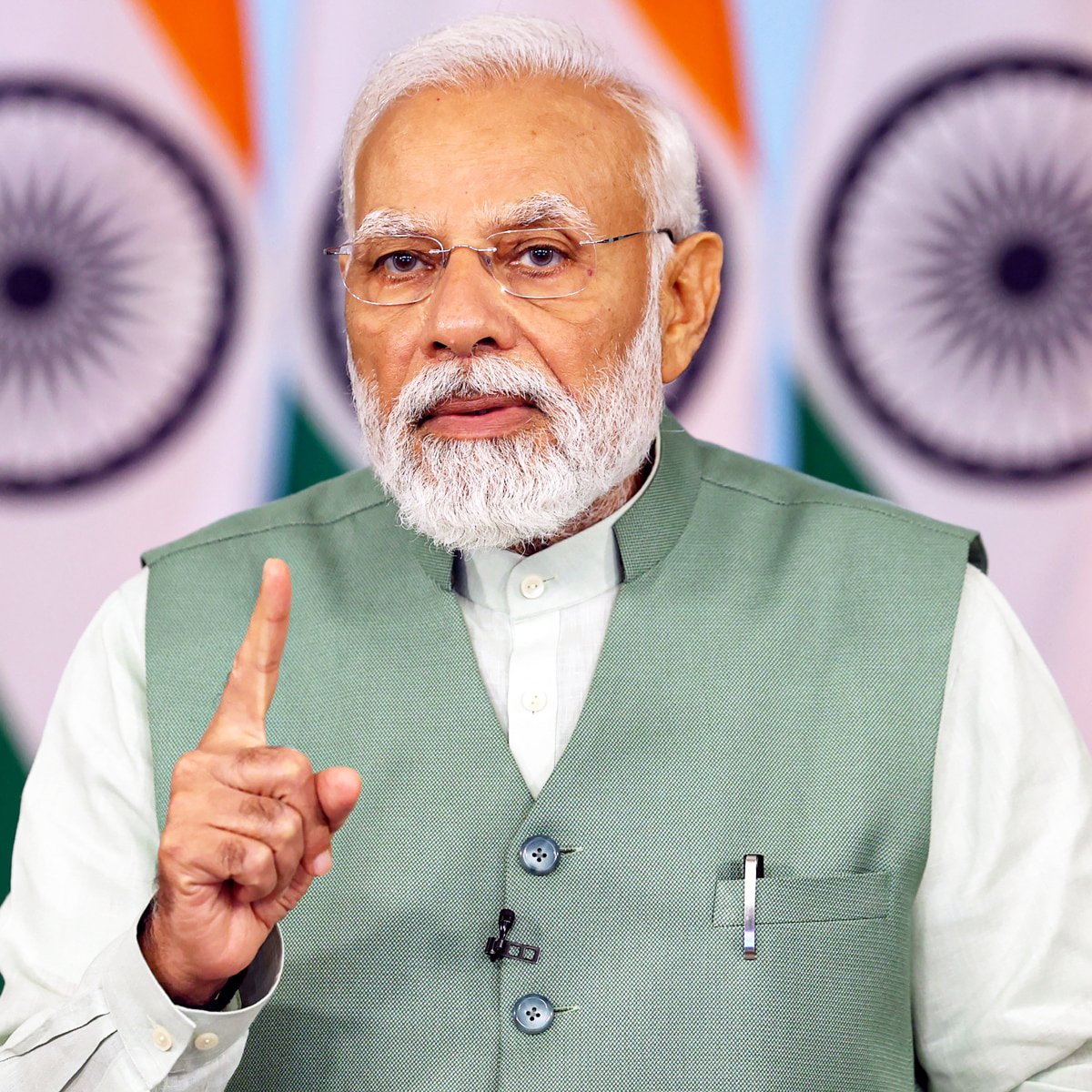
New Delhi, Sep 18,2025: Prime Minister Narendra Modi today spoke with Nepalese interim Prime Minister Sushila Karki, and reaffirmed India’s steadfast support for her efforts to restore peace and stability in the country.
Nepalese media, quoting the Prime Minister’s Secretariat, said that the two leaders were scheduled to speak via video conferencing today.
PM Modi in a post on X, said he also extended warm greetings to PM Karki and the people of Nepal on the occasion of their National Day tomorrow.
“Had a warm conversation with Mrs. Sushila Karki, Prime Minister of the Interim Government of Nepal. Conveyed heartfelt condolences on the recent tragic loss of lives and reaffirmed India’s steadfast support for her efforts to restore peace and stability.
“Also, I extended warm greetings to her and the people of Nepal on their National Day tomorrow.”
Prior to today’s conversation, on Tuesday, Indian Ambassador to Nepal, Naveen Srivastava, paid a courtesy call on Prime Minister Karki at Singha Durbar.
During the meeting, Ambassador Srivastava expressed India’s continued commitment to supporting Nepal’s progress and prosperity, assuring that this support would persist in the days ahead, too.
He further expressed India’s assistance in development and reconstruction, stating that India stands in favor of peace, good governance, and stability in Nepal.
Through the Indian Ambassador, Prime Minister Karki responded that she would discuss matters of mutual interest in detail with her Indian counterpart on Thursday, Nepal Khabar reported.
Earlier, in his message of congratulations to her on taking over as Interim Prime Minister, PM Modi had wished for Nepal’s prosperity, and during a speech at an event in Manipur, he had welcomed the formation of a civil government in Nepal following two days of widespread unrest by the Gen Z movement.
In the wake of the Gen Z mass movement and the consequent violence in Nepal, CPN (UML) Chairman KP Sharma Oli resigned from the post of Prime Minister on September 9.
President Ramchandra Paudel appointed former Chief Justice Sushila Karki as the Prime Minister of the interim government on the night of September 12.
President Paudel dissolved the Parliament (House of Representatives), and announced general elections for March 5, 2026.
UNI RN
Sept 18,2025: The Palestinian health ministry has said that at least 79 people have been killed in Gaza in the last 24 hours and 228 people have been in injured.
The health ministry added that a number of people remain trapped under the rubble of buildings which collapsed.
Hospitals in besieged Gaza City are on the “brink of collapse”, the World Health Organization (WHO) chief says, as Israel’s widely denounced ground invasion enters its third day.
The assault is “driving new waves of displacement, forcing traumatised families into an ever-shrinking area unfit for human dignity”, Tedros Adhanom Ghebreyesus said.
“The injured and people with disabilities cannot move to safety, which puts their lives in grave danger,” he said. “We call for an immediate end to these inhumane conditions. We call for a ceasefire.”
Israel’s military assault on Gaza City has forced hundreds of thousands of desperate Palestinians south and the humanitarian disaster is increasing in intensity, the UN says.
The Israeli military said it was opening an additional route for 48 hours that Palestinians could use to leave Gaza City as it stepped up efforts on Wednesday to empty the city of civilians and confront thousands of Hamas combatants.
Hundreds of thousands of people are sheltering in the city and many are reluctant to follow Israel’s orders to move south because of dangers along the way, dire conditions, a lack of food in the southern area and fear of permanent displacement.
At least 63 people were killed by Israeli strikes and gunfire across the Gaza Strip on Wednesday, with most of the casualties in Gaza City, local health authorities said.
They said the latest fatalities took the Palestinian death toll from the two-year war between Israel and Hamas past 65,000. Palestinian officials and rescue workers say the true figure is likely higher as many remains are trapped under the rubble of destroyed buildings.
The war was triggered by the Hamas-led attacks on southern Israel on October 7, 2023, in which about 1,200 people were killed and 251 taken hostage, according to Israeli tallies.
Israel estimates about 400,000 people, or 40% of those who were in Gaza City on August 10 – when it announced plans to take control – have already fled. The Gaza media office says 190,000 have headed south and 350,000 have moved to central and western areas of the city.
A day after Israel announced the launch of its ground offensive to seize control of Gaza’s main urban centre, tanks had moved short distances towards the city’s central and western areas from three directions, but no major advance was reported.
An Israeli official said military operations were focused on getting civilians to head south and that fighting would intensify over the next month or two.
The official said Israel expected around 100,000 civilians to remain in the city, which would take months to capture, and said the operation could be suspended if a ceasefire was reached with the Hamas militant group.
The prospects of a ceasefire appear remote after Israel attacked Hamas political leaders in Doha last week, infuriating Qatar, a co-mediator in ceasefire talks.
Defying global criticism of the attack, including a rebuke by Israel’s stalwart ally, the United States, Prime Minister Benjamin Netanyahu has said Israel would strike Hamas leaders anywhere.
DUBAI/ISLAMABAD, Sept 18,2025: Saudi Arabia and nuclear-armed Pakistan signed a formal mutual defense pact on Wednesday, in a move that significantly strengthens a decades-long security partnership amid heightened regional tensions.
The enhanced defense ties come as Gulf Arab states grow increasingly wary about the reliability of the United States as their longstanding security guarantor. Israel’s attack on Qatar last week heightened those concerns.
“This agreement is a culmination of years of discussions. This is not a response to specific countries or specific events but an institutionalization of longstanding and deep cooperation between our two countries,” a senior Saudi official told Reuters when asked about its timing.
Israel’s attempt to kill the political leaders of Hamas with airstrikes on Doha, while they were discussing a ceasefire proposal that Qatar is helping to mediate, infuriated Arab countries.
The pact could shift the strategic calculus in a complex region. Allies of Washington, Gulf monarchies have sought to stabilise ties with both Iran and Israel to resolve longstanding security concerns.
But the Gaza war has upended the region and Gulf state Qatar has been subjected to direct hits twice in a year, once by Iran and once by Israel.
The Saudi deal comes months after Pakistan fought a brief military conflict with rival India in May.
India’s ministry of external affairs spokesman, Randhir Jaiswal said in a post on social media website X on Thursday that India was aware of the development, adding it would study its implications for New Delhi’s security and for regional stability.
The senior Saudi official, who spoke on condition of anonymity, acknowledged the need to balance relations with Pakistan’s rival, India, also a nuclear power.
“Our relationship with India is more robust than it has ever been. We will continue to grow this relationship and seek to contribute to regional peace whichever way we can.”
Asked whether Pakistan would be obliged to provide Saudi Arabia with a nuclear umbrella under the pact, the official said: “This is a comprehensive defensive agreement that encompasses all military means.”
Pakistani state television showed Pakistani Prime Minister Shehbaz Sharif and Saudi Crown Prince Mohammed bin Salman, the kingdom’s de facto ruler, embracing after signing the agreement. In attendance was Pakistan’s army chief, Field Marshal Asim Munir, regarded as the country’s most powerful person.
JERUSALEM/CAIRO, Sept 17,2025: Israel unleashed a long-threatened ground assault on Gaza City on Tuesday, declaring “Gaza is burning” as Palestinians there described the most intense bombardment they had faced in two years of war.
An Israel Defence Forces official said ground troops were moving deeper into the enclave’s main city, and that the number of soldiers would rise in coming days to confront up to 3,000 Hamas combatants the IDF believes are still in the city.
“Gaza is burning,” Defence Minister Israel Katz posted on X. “The IDF strikes with an iron fist at the terrorist infrastructure and IDF soldiers are fighting bravely to create the conditions for the release of the hostages and the defeat of Hamas.”
BODIES TRAPPED UNDER RUBBLE, THOUSANDS FLEE
In launching the assault, Israel’s government defied European leaders threatening sanctions and warnings from even some of Israel’s own military commanders that it could be a costly mistake.
U.S. President Donald Trump sided with Israel, telling reporters at the White House that Hamas would have “hell to pay” if it used hostages as human shields during the assault.
Israeli Prime Minister Benjamin Netanyahu said Trump had invited him to the White House in two weeks, after both men have addressed an annual gathering of world leaders at the United Nations General Assembly.
In the latest expression of international alarm, a United Nations Commission of Inquiry concluded that Israel had committed genocide in Gaza. Israel called the assessment “scandalous” and “fake”.
United Nations Secretary-General Antonio Guterres said that what is happening in Gaza was horrendous and that the war in the Palestinian territory was morally, politically and legally intolerable.
Palestinian local health authorities said an Israeli strike had hit a vehicle carrying displaced people fleeing south near the coastal road in Gaza City. The latest deaths take Tuesday’s toll to at least 75, most of them in Gaza City.
The Israeli military did not immediately comment on the strike.
Where a missile had destroyed two multi-storey residential buildings during the night, people clambered over an immense mound of dislocated concrete to pry out victims, footage obtained by Reuters showed. A woman cried as a small child’s body was pulled from the wreckage, hastily wrapped in a green blanket and carried away.
RUBIO OFFERS U.S. SUPPORT, EU PLANS NEW SANCTIONS
Israel renewed calls on civilians to leave, and columns of Palestinians streamed towards the south and west in donkey carts, rickshaws, heavily laden vehicles or on foot.
Hours before the escalation, U.S. Secretary of State Marco Rubio said in Jerusalem that, while the United States wished for a diplomatic end to the war, “we have to be prepared for the possibility that’s not going to happen”.
In Brussels, a spokesperson for the EU executive said it would agree on Wednesday to impose new sanctions on Israel, including suspending certain trade provisions.
Netanyahu told a press conference on Wednesday that if there was one lesson learned from the Gaza war it was that Israel needs to create an “independent weapons industry” that can “withstand international constraints”.
The IDF said it estimated 40% of people in Gaza City had left. Hamas said 350,000 had left their homes in the eastern parts of the city, heading to displacement shelters in its central or western areas, while another 175,000 people had fled the city altogether, heading south.
Much of Gaza City was laid to waste in the early weeks of the war in 2023, but around 1 million Palestinians had returned there to homes among the ruins. Forcing them out means confining most of Gaza’s population to overcrowded encampments along the coast further south lacking food, medical supplies and space.
Israeli military spokesperson Effie Defrin said the military was adjusting its humanitarian efforts in light of the evacuations and “there will not be a situation of starvation in Gaza”.
Three more Palestinians died of malnutrition and starvation in the past 24 hours, Gaza’s health ministry said on Tuesday, raising total hunger deaths to at least 428. Israel says the extent of hunger has been exaggerated.
ISRAELI ARMY CHIEF PUSHED FOR CEASEFIRE DEAL, SOURCES SAY
Some Israeli military commanders have expressed concern that the Gaza City assault could endanger remaining hostages held by Hamas or be a “death trap” for troops.
Chief of Staff Eyal Zamir, at a meeting Netanyahu convened late on Sunday with security chiefs, urged the prime minister to pursue a ceasefire deal, according to three Israeli officials, two of whom were in the meeting and one of whom was briefed on its details.
Hamas attacked Israel in October 2023, killing about 1,200 people and taking 251 hostages, Israeli tallies show. Israel’s military assault against Hamas has killed over 64,000 Palestinians, Gaza’s health ministry says.
Tehran, Sept 16,2025: Iran has rejected references to a two-state solution for the Israeli-Palestinian conflict contained in the final communique of the Arab-Islamic emergency summit in Doha, saying the approach fails to address the root of the issue and accusing US policies of perpetuating Israeli aggression.
“The so-called two-state solution will not solve the Palestinian issue,” the Iranian Foreign Ministry said in a statement carried by state media, reports Iran International.
“The only real and lasting solution is the establishment of a single democratic state through a referendum with the participation of all Palestinians, inside and outside the occupied territories.”
The summit reaffirmed support for the Arab Peace Initiative and international resolutions calling for a two-state settlement with East Jerusalem as the Palestinian capital.
Tehran also disassociated itself from mentions of East Jerusalem, the 1967 borders and related terms in the communique, reiterating what it described as the Palestinian people’s “inalienable right to self-determination” and the use of “all necessary means” to achieve it.
The ministry also condemned what it called Israel’s alleged “brutal crimes.”
Yemen’s Iran-backed Houthi movement echoed the criticism, dismissing the communique as weak and symbolic.
Senior official Mohammed Ali al-Houthi said that “a simple and tiresome statement of condemnation will not prevent the crimes of the occupiers” and urged stronger measures.
The summit, convened in Doha this week following Israel’s September 9 strike on Qatar, condemned the attack as a breach of international law and declared full solidarity with Doha.
Israel has since admitted it is facing growing economic isolation, with Prime Minister Benjamin Netanyahu attributing it to a Qatar-backed political and media blockade, particularly in Western capitals, partially succeeding in disrupting economic cooperation.
In their final statement, Arab and Islamic leaders accused Israel of committing “genocide, ethnic cleansing, starvation and siege,” warning such actions undermine peace efforts.
Iran formally requested that its reservations over the two-state solution be recorded in the final report. It also ruled out any US role as mediator in the conflict, citing Washington’s close ties to Israel, while welcoming the mediation efforts of Qatar and Egypt.
London [UK], September 16,2025: In a demonstration of unity and political expression, thousands of British-Bangladeshis and members of the Bangladeshi diaspora gathered at London’s iconic Trafalgar Square on Monday to participate in a large-scale “Rally for Bangladesh.”Organised in opposition to what participants described as the “repressive Yunus regime,” the event was marked by slogans, speeches, and widespread calls for the restoration of democratic rights in Bangladesh.
On its official X account, Bangladesh Awami League stated, “The streets of London echoed with chants of “Joy Bangla” today as thousands gathered to declare their absolute lack of confidence in the Yunus regime in Bangladesh. British-Bangladeshis and expatriate Bangladeshis came together for a massive “Rally for Bangladesh” at the historic Trafalgar Square.”The Bangladesh Awami League emphasised the symbolic significance of the rally’s location, stating: “The choice of venue was symbol seeking to raise international awareness for the Liberation War. Today, more than five decades later, the same square once again reverberated with the spirit of resistance.”Highlighting the current political climate in Bangladesh, the party stated, “Today, as in 1971, the ‘Joy Bangla’ slogan remains effectively banned in Bangladesh under Yunus and his political allies. Every day, Awami League supporters are charged under the Anti-Terrorism Act simply for exercising their democratic right to speech and assembly- whether by joining processions or raising slogans. Hundreds of thousands of AL activists and supporters, including doctors, lawyers, academics, journalists, commentators, and even freedom fighters have been arrested by the Yunus regime for defending the values and ethos of the 1971 Liberation war.
“Concluding with a message of unity, Bangladesh Awami League stated, “Today’s rally was therefore more than just a demonstration. It was a message of solidarity. A message from the diaspora to those being persecuted in Bangladesh- You are not alone.”
Sept 14,2025: United States Secretary of State Marco Rubio visited Jerusalem’s Western Wall on Sunday alongside Prime Minister Benjamin Netanyahu, commencing a week-long trip to Israel focusing on the Gaza conflict.
At the Jewish holy site, Rubio prayed for “peace” in Israel and beyond, while Netanyahu hailed US-Israel relations, amid rising global tensions following the IDF’s strike against Hamas leaders in Qatar last week and its plan to conquer Gaza City next month.
“I think [Rubio’s] visit here is a testimony to the durability, the strength of the Israeli-American alliance, that is as strong and durable as the stones of the Western Wall that we just touched,” Netanyahu told reporters at the site.
As is traditional at the landmark, Rubio inserted a note into the cracks of the wall, which read: “May peace reign upon this Holy Land and in the world.”
Joined by US Ambassador to Israel Mike Huckabee and the three officials’ wives, the two prayed for the safety of the hostages held by Hamas in Gaza and offered a special prayer for US President Donald Trump.
Following the prayers, the group toured newly opened archaeological excavations from the Second Temple period (516 BCE – 70 CE) in nearby underground tunnels along the Wall, led by Mordechai Suli Eliav, the CEO of the Western Wall Heritage Foundation.
“Under President Trump, and Secretary Rubio, and their entire team, this alliance has never been stronger, and we deeply appreciate it,” the premier said following the tour, before the two shook hands and left the site together.
Rubio did not make public remarks, and neither official took questions from reporters. Neither side’s office provided an account of a bilateral meeting between the two leaders.
Later on Sunday, Rubio wrote on X that he was “Honored to visit the [Western Wall] in Israel’s eternal capital, Jerusalem,” alongside Netanyahu and Huckabee.
On Monday, Rubio and Netanyahu will meet for talks at 10 a.m. and will issue joint statements in the early afternoon, the State Department said.
Rubio is also slated to meet with Foreign Minister Gideon Sa’ar and President Isaac Herzog in Jerusalem, and is also expected to take part in the inauguration of a new tunnel in Jerusalem’s Old City for visitors approaching the Temple Mount, the holiest site for Jews, which is also sacred for Muslims as the site of the Al-Aqsa Mosque.
Following the Western Wall visit, Netanyahu convened a meeting on the hostages in Gaza, the office of one of the attending ministers told The Times of Israel.
Rubio arrived in Israel on Sunday morning as tensions rose between Jerusalem and foreign capitals, and as the IDF intensified its attacks against northern Gaza.
The visit came less than a week after the military attacked Hamas leaders inside the US ally Qatar’s capital city, Doha, sparking fierce regional and global condemnation and causing concern over fallout with Qatar, its neighboring Gulf states, and the Trump administration.
On Friday, Trump and special envoy Steve Witkoff had dinner with the Qatari Prime Minister Sheikh Mohammed bin Abdulrahman al-Thani in New York, after al-Thani held a four-hour-long meeting with Vice President JD Vance and Rubio at the White House.
On the tarmac in Washington ahead of his flight, Rubio told reporters that the US was “not happy” about the seemingly failed Israeli strike, but said the attack will not change Washington’s allied status with Israel.
The secretary added that Trump “wants Hamas defeated, he wants the war to end, he wants all 48 hostages home, including those that are deceased, and he wants it all at once,” Rubio continued. “And we’ll have to discuss about how the events last week had an impact on the ability to achieve that in short order.”
Rubio’s arrival also came as fighting in Gaza City continued to intensify on Sunday, with Palestinians continuing to flee amid looming Israeli plans to capture the city.
Rubio said ahead of the trip that he will be seeking answers from Israeli officials about how they see the way forward in Gaza.
The secretary’s trip also marks a show of support as a flurry of Western states prepare to recognize a Palestinian state at the United Nations General Assembly this month.
According to the Axios news site, among the topics that Rubio will discuss with Israeli officials is the potential annexation of the West Bank as a response to Western nations’ planned recognition of a Palestinian state.
Rubio has warned countries considering recognizing Palestinian statehood during the UNGA that Israel could take “reciprocal” action in the form of annexing the West Bank.
Two Israeli officials told Axios that “Rubio has signaled in private meetings that he doesn’t oppose West Bank annexations and the Trump administration won’t stand in the way.”
At the same time, the report cited a US official saying White House and State Department officials who have held internal meetings on the issue fear Israeli annexation of parts of the West Bank “would lead to the collapse of the Abraham Accords and tarnish Trump’s legacy.”
Netanyahu signed an agreement on Thursday to advance a West Bank settlement expansion plan cutting across land the Palestinians seek for a state — a move the United Arab Emirates warned could undermine the US-brokered Abraham Accords that normalized UAE-Israel ties.
The report said Netanyahu wants “to figure out from Rubio” how much leeway he has on annexation.
Churachandpur, Sep 13,2025: Prime Minister Narendra Modi today assured the people of Manipur that he and his government are ‘’with them’’ and appealed for peace saying the land of courage and strength must once again become the land of hope.
Addressing the people of the state, especially the tribal people in hill districts of the state, he said that while recent violence has deeply affected lives, hope is knocking at the doors of Manipur.
The Prime Minister, who met displaced families staying in relief camps, said that the government at the Centre stood firmly with the people of Manipur.
“I appeal to all organisations to walk the path of peace and ensure the future of their children. I promise, I am with you. The Indian government is with you,” he said.
He also underlined the cultural vibrancy and resilience of the state, adding that Manipur’s sentiment, courage and affection were unforgettable and that he bows his head in gratitude before the people.
Emphasising his government’s commitment to development, Modi recalled that in the last decade the state has seen unprecedented investment in connectivity, infrastructure, health and education.
He noted that road and rail projects worth thousands of crores have transformed access across hills and plains, with Rs 3,700 crore already spent on national highways and another Rs 8,700 crore worth of work underway. Rail connectivity alone has seen an investment of Rs 22,000 crore, while Imphal airport has been upgraded at a cost of Rs 400 crore.
He said that the efforts to improve the lives of the people have touched every household, from 60,000 new homes and free electricity for more than one lakh families to 3.5 lakh households now getting drinking water under the Har Ghar Jal scheme.
The health sector, which had long been neglected, is also undergoing change with a medical college set up in Churachandpur and advanced facilities coming up in five hill districts. A special package of Rs 3,000 crore, including Rs 500 crore for displaced families, has been announced to help Manipur get back on its feet.
The Prime Minister stressed that more than 500 villages are currently witnessing development works, with particular focus on empowering tribal youth and women. He said Manipur is a symbol of peace, prosperity and progress, and the government will continue to stand with displaced families until they return to their homes and rebuild their lives.
He also laid the foundation for 19 projects worth Rs 7,300 crore and expressed confidence that in the coming years Manipur would shine as a true jewel of the Northeast.
UNITED NATIONS, Sept 12,2025: The United Nations General Assembly on Friday overwhelmingly voted to endorse a declaration outlining “tangible, time bound, and irreversible steps” towards a two-state solution between Israel and the Palestinians ahead of a meeting of world leaders.
The seven-page declaration is the result of an international conference at the U.N. in July – hosted by Saudi Arabia and France – on the decades-long conflict. The United States and Israel boycotted the event.
A resolution endorsing the declaration received 142 votes in favor and 10 against, while 12 countries abstained.
The vote comes ahead of a meeting of world leaders on September 22 – on the sidelines of the high-level U.N. General Assembly.
The declaration endorsed by the 193-member General Assembly condemns the attacks against Israel by Palestinian militants Hamas on October 7, 2023, which triggered the war in Gaza.
It also condemns the attacks by Israel against civilians and civilian infrastructure in Gaza, siege and starvation, “which have resulted in a devastating humanitarian catastrophe and protection crisis.”
French Foreign Minister Jean-Noel Barrot said the resolution secured the international isolation of Hamas.
The resolution was supported by all Gulf Arab states. Israel and the United States voted against it, along with Argentina, Hungary, Micronesia, Nauru, Palau, Papua New Guinea, Paraguay and Tonga.
The declaration endorsed by the resolution says the war in Gaza “must end now” and support the deployment of a temporary international stabilization mission mandated by the U.N. Security Council.
The United States described the vote as “yet another misguided and ill-timed publicity stunt” that undermined serious diplomatic efforts to end the conflict.
“Make no mistake, this resolution is a gift to Hamas,” U.S. diplomat Morgan Ortagus told the General Assembly. “Far from promoting peace, the conference has already prolonged the war, emboldened Hamas and harmed the prospects of peace in both short and long term.”
Israel, which has long criticized the U.N. for not condemning Hamas by name for the October 7 attacks, dismissed the declaration as one-sided and described the vote as theater.
“The only beneficiary is Hamas …When terrorists are the ones cheering, you are not advancing peace; you are advancing terror,” Israel’s U.N. Ambassador Danny Danon said.
The October 7, 2023, Hamas attack on Israel killed 1,200 people, mostly civilians, and about 251 were taken hostage, according to Israeli tallies. More than 64,000 people, also mostly civilians, have since been killed during the war in Gaza, according to local health authorities.
WASHINGTON, Sept 13,2025: Group of Seven nations’ finance ministers discussed in a call on Friday further sanctions on Russia and possible tariffs on countries that they consider “enabling” its war in Ukraine, as the U.S. called on its allies to impose tariffs on purchasers of Russian oil.
Canadian Finance Minister Francois-Philippe Champagne chaired the G7 meeting, which was held to discuss further measures to increase pressure on Russia to end its war against Ukraine, according to a statement from Canada, the head of the rolling G7 presidency.
The ministers agreed to speed up discussions to use frozen Russian assets to fund Ukraine’s defense, and discussed a “wide range of possible economic measures to increase pressure on Russia, including further sanctions and trade measures, such as tariffs, on those enabling Russia’s war effort,” the statement said.
U.S. Treasury Secretary Scott Bessent told finance ministers during the call that they should join the U.S. in imposing tariffs on countries that purchase oil from Russia, Bessent and U.S. Trade Representative Jamieson Greer said in a separate statement following the meeting.
“Only with a unified effort that cuts off the revenues funding Putin’s war machine at the source will we be able to apply sufficient economic pressure to end the senseless killing,” Bessent and Greer said.
Bessent and Greer welcomed commitments made during the call to increase sanctions pressure and explore using immobilized Russian sovereign assets to benefit Ukraine’s defense, according to the joint statement.
Earlier in the day, a U.S. Treasury spokesperson called on G7 and European Union allies to impose “meaningful tariffs” on goods from China and India to pressure them to halt their purchases of Russian oil.
President Donald Trump has imposed an extra 25% tariff on imports from India to pressure New Delhi to halt its purchases of discounted Russian crude oil, bringing total punitive duties on Indian goods to 50% and souring trade negotiations between the two democracies.
But Trump has refrained from imposing additional tariffs on Chinese imports over China’s purchases of Russian oil, as his administration navigates a delicate trade truce with Beijing.
Bessent is due to travel to Madrid on Friday for another round of talks with his Chinese counterpart, Vice Premier He Lifeng, that will cover trade issues, Washington’s demands for Chinese-owned TikTok to divest its U.S. operations, and anti-money laundering issues.
Kathmandu [Nepal], September 11,202: The death toll from the ongoing Gen Z protests in the Kathmandu Valley has climbed to 31, The Kathmandu Post reported, citing officials from the Department of Forensic Medicine at Tribhuvan University Teaching Hospital, where the deceased have been brought for postmortem examinations. As per The Kathmandu Post on Wednesday, so far the identities of 25 victims have been preliminarily confirmed.The remaining six individuals, five men and one woman, are yet to be identified.Moreover, over 1000 people were injured in the protest across the region. Meanwhile, the wife of Former Nepalese PM Khanal is currently in a critical condition after an arson attack that took place during the violent demonstrations across the country, The Kathmandu Post reported.Despite earlier reports stating that she was killed in the arson attack, Ravi Laxmi Chitrakar, the wife of former PM and senior CPN (Unified Socialist) leader Jhala Nath Khanal, is in critical condition after suffering severe burns.As per The Kathmandu Post, Chitrakar was admitted to Kirtipur Hospital on Tuesday following the incident, which occurred when demonstrators set fire to her residence in the Dallu area of Kathmandu while she was still inside.
Negotiations are also on between the Nepalese Army, Nepal’s President Ram Chandra Paudel, and representatives of Gen Z youth to determine the leadership of an interim government amid ongoing political unrest, The Himalayan Post reported.According to The Himalayan Post, citing sources, the Gen Z protest leaders have chosen Nepal’s former Chief Justice Sushila Karki as their unanimous nominee for the interim Prime Minister position.The talks will begin between Karki’s team and the Army leadership, including Chief of Army Staff Ashok Raj Sigdel, and may proceed to the President’s Office at Sheetal Niwas depending on how the situation unfolds.Kathmandu Metropolitan City Mayor Balendra Shah ‘Balen’ has also voiced his support for Karki, strengthening her standing as the agreed-upon candidate of the Gen Z movement.
The protests began on September 8, 2025, in Kathmandu and other major cities, including Pokhara, Butwal, and Birgunj, following the government’s imposition of a ban on major social media platforms, citing concerns over tax revenue and cyber security.Curfew was imposed in several cities, including Kathmandu, to control the situation, which will continue till Friday morning, as per a statement issued by the Nepalese Army.Protesters have been demanding an end to “institutionalised corruption and favouritism” in governance. They want the government to be more accountable and transparent in its decision-making processes. Public frustration deepened further when the “Nepo Babies” trend on social media exposed the lavish lifestyles of politicians’ children, highlighting the economic disparity between them and ordinary citizens.
New Delhi/Kathmandu, Sep 10,2025: Army took control of Nepal security today after two days of debilitating political turbulence that left 21 people dead and more than 300 injured and saw residences of prominent Ministers either torched or vandalised forcing Prime Minister K P Sharma Oli and four of his cabinet colleagues to resign.
Capital Kathmandu witnessed semblance of normalcy after Army took over the security and an uneasy calm prevailed. However, the scars of two days of unbridled violence by the youth, described as Gen Z protestors, were quite visible with torched and vandalised residences and smoke billowing out from some areas.
Nepal’s Parliament building and the Supreme Court were set on fire by the protestors and there were reports of a meeting between Nepal’s President, the Army and Gen Z leaders.
India issued an advisory asking Indians in Nepal to stay indoors and not move around. Several Indian airlines have also stopped flights to and from Kathmandu while security on the Indo-Nepal border has been tightened.
The Gen Z were protesting against corruption and the government’s ban on 26 social media platforms including Facebook, Instagram, WhatsApp etc. Although the government removed the ban on social media platforms the first day itself, violence did not stop.
The violence was the outcome of years of frustration and suppressed anger among younger generation against the children of Nepalese elite—described as ‘Nepo kids’–who flaunted their expensive belongings while the common people lived in poverty.
The cycle of violence was triggered on September 6 when hours after ban on social media, an eleven year old school student was hit by a Minister’s vehicle in Lalitpur. The Minister’s vehicle drove away abandoning the school child. The Prime Minister reportedly described it as a ‘’normal incident’’ and promised to cover the student’s medical expenses only. This fuelled the already simmering anger among the youth (Gen Z).
The violence escalated with hundreds of ‘Gen Z’ protestors setting fire to the residences of Prime Minister K P Sharma Oli and several other leaders yesterday. Prime Minister Oli resigned ‘’to pave way for the constitutional solution of the current crisis.’’ Minister for Water Supply Pradeep Yadav, Minister for Agriculture and Livestock Ram Nath Adhikari and Sports Minister Tejulal Chaudhary also submitted their resignations. Home Minister Ramesh Lekhak had resigned on Monday.
Residences of several high profile politicians were vandalised, including those of Prime Minister Oli and former Prime Minister Sher Bahadur Deuba. The protesters also vandalised and set on fire the house of Energy Minister Deepak Khadka.
India said it is closely monitoring the developments and expressed hope that restraint will be exercised and all issues addressed through peaceful means and dialogue. Indian nationals were advised to exercise caution and stick to the guidelines issued by the Nepali authorities.
The External Affairs Ministry said in a statement “We are closely monitoring the developments in Nepal since yesterday and are deeply saddened by the loss of many young lives…As a close friend and neighbour, we hope that all concerned will exercise restraint and address any issues through peaceful means and dialogue….Indian nationals in Nepal are advised to exercise caution and adhere to the steps and guidelines issued by the Nepali authorities.”
Amid the escalating violence security forces moved Nepalese leaders to safe locations by helicopter.
Curfew was imposed in many parts including capital Kathmandu and Lalitpur. However, protestors defied the curfew and barged into the Singha Durbar. Domestic flights came to a standstill while reports said the Tribhuvan International Airport in Kathmandu was partially closed.
Several countries Including United States, Australia, Finland, France, Japan, South Korea and UK have expressed sadness over the violence and loss of lives. In a statement they said, “We are deeply saddened by the violence seen in Kathmandu and elsewhere in Nepal today, including the tragic loss of life and injury during demonstrations. We extend our sincere condolences to the families of the victims, all those affected, and wish those injured a swift and full recovery.”
They also expressed support and solidarity for the universal rights of peaceful assembly and freedom of expression. “Our governments reaffirm our strong support for the universal rights of peaceful assembly and freedom of expression.”
The countries also urged all parties to exercise maximum restraint, avoid further escalation, and ensure that fundamental rights are protected, according to the statement.
UN Secretary General said in a statement that security forces “must comply with the basic principles on the use of force”. “The United Nations is obviously following the situation with a lot of concern. It’s critical that the authorities, the government, protect and respect the rights of peaceful assembly and freedom of expression.
Paris, Sep 9,2025: Nearly nine months after the toppling of his predecessor Michel Barnier, France has again plunged into a new political crisis following the defeat of Prime Minister François Bayrou at a confidence vote in the National Assembly on Monday.
Bayrou’s fate was sealed after he unveiled his plan for a confidence vote late last month, when leaders from the far-left France Unbowed, far-right National Rally and centre-left Socialist Party all announced they would vote to bring down the government.
The defeat – by 364 votes to 194 – means that Bayrou will on Tuesday present his government’s resignation to President Emmanuel Macron, who must now decide how to replace him.
Macron’s office said this would happen “in the coming days”, reports BBC.
The options before Macron include naming a new prime minister from the centre-right; pivoting to the left and finding a name compatible with the Socialist Party and dissolving parliament so new elections are held.
France is thus on its way to getting a fifth prime minister in less than two years. Before Bayrou, previous prime minister Michel Barnier was toppled in December last year.
Bayrou’s fall came after he supported his government on an emergency confidence debate on the question of French debt.
There was no sign that Bayrou’s warnings have had any impact on parliament or on France as a whole.
Deputies from the left and hard-right accused him of trying to mask his own and Macron’s responsibility in bringing France to its current state.
He warned of the “existential” threat to France if it did not start to tackle its €3.4 trillion liability.
In a budget for 2026 he proposed to scrap two national holidays and freeze welfare payments and pensions, with the aim of saving €44 billion.
Party after party made quite clear they saw Monday’s vote as an opportunity to settle accounts with Bayrou – and through him Macron.
In absence of any majority in the National Assembly, Bayrou saw the left and hard-right uniting against him – and his fate was sealed.
In his speech beforehand, Bayrou made clear that he had his eyes set more on history rather than politics, telling MPs that it was future generations who would suffer if France lost its financial independence.
“Submission to debt is the same as submission to arms,” he said, warning that current debt levels meant “plunging young people into slavery”.
“You may have the power to bring down the government. But you cannot efface reality,” he said.
Bayrou’s warnings have had a significant impact on parliament or on France as a whole, with deputies from the left and hard-right accusing him of trying to cover his own and Macron’s responsibility in bringing France to its current state.
While, the polls showed that few regard debt control as a national priority, as opposed to the cost of living, security and immigration.
A movement calling itself Bloquons Tout (Let’s Block Everything) has promised a wave of sit-ins, boycotts and protests against Macron’s policies from this Wednesday.
The need for financial restraint comes as Macron promises extra funds for defence, and as opposition parties demand the repeal of the latest pension reform that raised the retirement age to 64.
Bayrou took over from Michel Barnier last December after Barnier failed to get his budget through the Assembly.
There are speculations that Macron would turn now to a left-wing prime minister, having failed with the conservative Barnier and the centrist Bayrou.
However the Socialist Party says it wants a total break from Macron’s pro-business policies as well as a repeal of the pension reform.
It therefore seems likely Macron will look initially to another figure from within his own camp, with Defence Minister Sébastien Lecornu, Labour Minister Catherine Vautrin and Finance Minister Éric Lombard all said to be in the running.
Among the probable candidates, Lecornu is widely expected to become the next PM.
The 39-year-old politician is the only minister to have remained in government since President Macron was first elected in 2017, outlasting countless reshuffles and a snap election.
Over the past seven years, Lecornu has established his credentials as a loyal Macron ally, honing a political style that chimes well that of the president — in particular his engagement with local-level politics.
A
Washington DC [US], September 8,2025: US President Donald Trump on Saturday issued a final ultimatum to Hamas as 48 hostages continue to remain in captivity. In a sharply worded post on Truth Social, the US President said that Israel has accepted his terms and it is about time Hamas accepts it as well. Trump said that he has warned Hamas about the consequences and called his message the “last warning”, underscoring that there will not be another one. “Everyone wants the Hostages HOME. Everyone wants this War to end! The Israelis have accepted my Terms. It is time for Hamas to accept as well. I have warned Hamas about the consequences of not accepting. This is my last warning, there will not be another one! Thank you for your attention to this matter.”According to a report by the Times of Israel, of the 48 hostages in Gaza — roughly 20 of whom are believed to be still alive.Times of Israel reported that soon after Trump’s statement, Hamas, in a carefully worded statement said that it “is ready to immediately sit at the negotiating table to discuss the release of all prisoners in exchange for a clear declaration to end the war, a total withdrawal from the Gaza Strip, and creation of a committee of independent Palestinians to run the Gaza Strip.”According to the Times of Israel, the statement said, “Hamas welcomes any move that helps the efforts to stop the aggression against our people,”. The statement affirmed that it received “some ideas from the American side aimed at reaching a ceasefire”, Times of Israel said and further reported that Hamas said of being in “constant contact with the mediators to turn these ideas into a comprehensive agreement that meets our demands.”Notably, the remarks by the US President come shortly after on Saturday, CENTCOM’s Admiral Brad Cooper concluded his visit to Israel where he held a situational assessment along with Israel’s Chief of the General Staff, LTG Eyal Zamir. CENTCOM is responsible for “defending and promoting U.S. interests in 20 nations in the Middle East, Central and South Asia, and the strategic waterways that surround them”, as described by the official website of the US government. The official statement by the Israeli Defence Forces (IDF) said, “In the situational assessment, they discussed the current operational picture and the plans going forward. In addition, Admiral Cooper toured the communities near the Gaza Strip”. The statement noted that Admiral Cooper’s visit focused on the operational cooperation between the IDF and the U.S. military, maintaining regional stability in both nearby and distant arenas, and strengthening joint efforts to address the challenges and threats in the region.
Lalitpur [Nepal], September 8,2025: The CPN-UML (Communist Party of Nepal- Unified Marxist Leninist) has expressed serious disagreement with the agreement between India and China to use Nepal’s Lipulekh for trade.Endorsing the special document that concluded on Sunday, the UML has called on both countries to withdraw from the arrangement.The party has urged the Nepalese government to resolve the issue through high-level diplomatic initiatives and assert Nepal’s rights over the region east of the Kali River. This was included in a 28-point contemporary proposal passed by the policy convention.
The proposal highlighted Prime Minister and UML Chair KP Sharma Oli’s disagreement over the Lipulekh trade route agreement during his China visit from August 30 to September 3, noting that “this stance elevated Nepal’s international standing.” It also cited bilateral and multilateral engagements during the trip that enhanced the country’s visibility abroad.India and China have agreed to reopen border trade through Lipulekh Pass, a point located 56 kilometres inside Nepal’s western frontier in Limpiyadhura. The agreement was made during Chinese Foreign Minister Wang Yi’s visit to India in August. Both countries made the agreement during a meeting between the Indian External Affairs Minister S. Jaishankar and the Chinese Foreign Minister Wang Yi. Point nine of the joint communique mentions the resumption of border trade. “Both sides agreed to the re-opening of border trade through the three designated trading points, namely Lipulekh Pass, Shipki La Pass and Nathu La Pass.”Nepal’s Ministry of Foreign Affairs had objected to the agreement of India and China to open a trade route via Lipulekh, asserting a claim over the land. Issuing a statement, the Ministry asserted claims over the land, objecting to the unilateral move by China and India.
Responding to the release by Nepal’s Foreign Ministry, India’s Ministry of External Affairs (MEA) rejected Kathmandu’s claim and reiterated that trade through the route existed for decades.The statement released by Randhir Jaiswal, the Spokesperson for the MEA, claimed that the trade had been disrupted in recent years due to COVID and other developments, and both sides had now agreed to resume it. On Nepal’s territorial claims, Jaiswal said such claims were “neither justified nor based on historical facts and evidence,” describing them as “untenable.”
Earlier in 2020, Nepal amended its constitution, incorporating a new political and administrative map in the preamble of the constitution. The new map included the tri-junction of Limpiyadhura, Kalapani and Lipulekh, which has remained a disputed area between Nepal and India. Nepal’s updated map, prepared incorporating the missing territories, was submitted to the Ministry of Land Management by the Department of Survey, which claims to have taken accurate scale, projection and coordinate system. It was publicly released on 20 May 2020 after a go-ahead signal from the Cabinet meeting on 18th May of the same year.The department has collected a map drawn during the Treaty of Sugauli, another brought from London, receipts of payment of land revenues and the order issued by the then Prime Minister Chandra Shumsher, as evidence to claim the land belongs to Nepal.The earlier map issued in 2032 BS had left Gunji, Nabhi and Kuri villages, which have now been included in the recently revised map, adding 335 square kilometres of land.Tensions had flared between New Delhi and Kathmandu in 2020 after the issuance of a political map by Nepal in mid-May, including the tri-junction, which India had earlier included in its November 2019 map.Diplomatic ties between the nations severed further after the inauguration of road linking Kailash Mansarovar via Lipulekh on May 8, 2020 after which Nepal handed over diplomatic note to India objecting the move.Prior to the handover of the diplomatic note, Nepal also had strongly objected to India’s unilateral move to construct the road. Nepal said it has “consistently maintained” that as per the Sugauli Treaty (1816), “all the territories east of Kali (Mahakali) river, including Limpiyadhura, Kalapani and Lipu Lekh, belong to Nepal.”The Indian Defence Ministry had said the Border Road Organisation (BRO) in Uttarakhand has connected the Kailash Mansarovar route to the Lipulekh pass, which will provide connectivity to border villages and security forces.
India and China discussed the Lipulekh pass for the first time in a decade, following the 2015 visit to China by Indian Prime Minister Narendra Modi. During Modi’s visit, then Chinese Premier Li Keqiang agreed to expand trade via Lipulekh. The joint statement issued on May 15, 2015, included the agreement in point 28.The 2015 decision triggered strong protests in Nepal as the agreement was reached without its consultation, despite the pass lying within Nepali territory. The Nepal government formally objected at the time, sending diplomatic notes to both countries.With India and China working to improve strained relations following the 2020 Galwan Valley clashes, both sides have once again agreed to open trade through Lipulekh. Nepal’s official map includes Lipulekh within its territory.In 2023, China released a new map showing Lipulekh, Kalapani, and Limpiyadhura as part of India, further complicating the dispute.
WASHINGTON, Sept 6,2025: The United States is not talking about regime change in Venezuela, President Donald Trump said on Friday, as the United States ordered an additional 10 stealth fighter jets to a military buildup in the Caribbean.
“We’re not talking about that, but we are talking about the fact that you had an election which was a very strange election, to put it mildly,” Trump said, referring to the contested 2024 election the Venezuelan government says President Nicolas Maduro won.
Trump had been asked by reporters about a claim Maduro has made this week that the United States was seeking “regime change through military threat.”
“The government of the United States should abandon its plan of violent regime change in Venezuela and in all of Latin America and respect sovereignty, the right to peace, to independence,” Maduro said on state television.
“I respect Trump. None of the differences we’ve had can lead to a military conflict,” Maduro added. “Venezuela has always been willing to converse, to dialogue.”
Trump demonstrated his new approach to fighting the drug war with a U.S. military strike on Tuesday that killed 11 people and sank a boat from Venezuela which Trump said was transporting illegal narcotics.
The U.S. president is weighing options for further strikes, including potentially attacking suspected drug cartel targets inside Venezuela, CNN reported on Friday, citing multiple sources briefed on the administration’s plans. Such a strike would mark a major escalation.
‘THEY’LL BE SHOT DOWN’
The Trump administration has ordered the deployment of 10 F-35 fighter jets to a Puerto Rico airfield to conduct operations against drug cartels, sources told Reuters on Friday.
The new deployment comes on top of an already bristling U.S. military presence in the southern Caribbean as Trump carries out a campaign pledge to crack down on groups funneling drugs into the United States.
The disclosure about the F-35s came just hours after the Pentagon accused Venezuela of a “highly provocative” flight on Thursday by fighter jets near a U.S. Navy warship.
Trump warned Venezuela that the U.S. military had authorization to shoot down the jets if commanders believed they needed to, saying: “If they do put us in a dangerous position, they’ll be shot down.”
At every turn, the Trump administration has sought to tie Maduro’s government to narco trafficking, allegations Caracas denies.
Specifically, Trump has accused Maduro of running the Tren de Aragua gang, which his administration designated a terrorist organization in February. Maduro has denied any connection to Tren de Aragua, which his government says was rendered inactive in Venezuela by a prison raid in 2023.
Trump on Friday compared the deaths of hundreds of thousands of Americans in overdoses to war dead, as he sought to justify the muscular military activity in the Caribbean.
“Think if you’re in a war and you lose 300,000 … We’re not going to allow it to happen,” he said.
Venezuela’s Communications Ministry did not respond to a request for comment about the F-35s or the allegations that Venezuelan fighter jets flew over a U.S. warship.
DEMOCRAT CONDEMNS ‘LAWLESS’ ACTS
The sources, speaking on condition of anonymity about the latest U.S. deployment, said the 10 fighter jets are being sent to conduct operations against designated narco-terrorist organizations operating in the southern Caribbean. The planes should arrive in the area by late next week, they said.
F-35s are highly advanced stealth fighters and would be effective in combat against Venezuela’s air force, which includes F-16 aircraft.
A U.S. official, speaking on condition of anonymity, said two Venezuelan F-16s flew over the guided missile destroyer Jason Dunham on Thursday. The Dunham is one of at least seven U.S. warships deployed to the Caribbean, carrying more than 4,500 sailors and Marines.
U.S. Marines and sailors from the 22nd Marine Expeditionary Unit have also been carrying out amphibious training and flight operations in southern Puerto Rico.
The buildup has put pressure on Maduro, whom U.S. Defense Secretary Pete Hegseth has called “effectively a kingpin of a drug narco state.”
U.S. Representative Ilhan Omar, a Democrat from Minnesota, condemned what she called Trump’s “lawless” actions in the southern Caribbean.
“Congress has not declared war on Venezuela, or Tren de Aragua, and the mere designation of a group as a terrorist organization does not give any President carte blanche to ignore Congress’s clear Constitutional authority on matters of war and peace,” Omar said in a statement.
U.S. officials have not clearly explained what legal justification was used for Tuesday’s air strike on the boat or what drugs were on board.
Trump said on Tuesday, without providing evidence, that the U.S. military had identified the crew of the vessel as Tren de Aragua members.
New Delhi, Sep 5,2025: Industrialist Harsh Goenka has slammed White House Trade Advisor Peter Navarro for his casteist remark on Indian billionaires that ‘Brahmins’ were profiteering at the expense of common Indians.
Harsh Goenka, chairman of RPG enterprises, posted on X “ Dear Peter Navarro, India’s boardrooms aren’t run by Brahmins. Tata? Not Brahmin. Reliance ? Not Brahmin. Mahindra? Not Brahmin. Wipro? Not Brahmin. Birla? Not Brahmin.”
“But India’s soldiers, scientists, poets? Many were. From Param Vir Chakra heroes to Nobel minds like CV Raman, S Chandrasekhar, and Tagore. Unlike some others who are trying to lobby for the Nobel prize, our Brahmins got their prize only through merit,” Goenka said while taking a dig at US President Donald Trump for lobbying for Nobel Prize.
Earlier this week, Navarro accused India of being an ‘Oil money laundromat for the Kremlin’ and claimed that Brahmins were profiteering at the cost of ordinary Indians. The remark was slammed as casteist, racist, and misplaced.
However, Navarro himself got trapped after commenting ‘Brahmins are profiteering’ due to once popular ‘Boston Brahmins’ in US who were the members of Boston’s historic upper class.
The term ‘Boston Brahmin’ was coined by author Oliver Wendell Holmes Sr. in 1861, which was used to describe a small, exclusive group of Anglo-Saxon protestant families who traced their lineage back to the earliest English Colonialists of Massachusetts Bay.
Navarro’s remark blurred two worlds: India’s caste hierarchy and America’s old “Boston Brahmins,” a wealthy Protestant elite. But Goenka’s response today cut through the noise. Reminding Navarro that India’s strength lies not in stereotypes, but in the achievements of its people.
Goenka signed off as ‘An Indian (Not a Brahmin)
NEW DELHI, Sept 4,2025: Finance Minister Nirmala Sitharaman unveiled tax cuts for hundreds of consumer items, from soap to cars, in the biggest overhaul of the goods and services tax (GST), set to take effect from September 22.
Here are key highlights:
MAJOR CHANGES
India will have two key tax rates of 5% and 18% from September 22, versus four now. A new tax slab of 40% will apply to high-end goods, but all additional levies above that are to be abolished, bringing down effective tax rates on mid-size and big cars.
REVENUE LOSS, INFLATION IMPACT
The government estimates the cuts will cause revenue loss of 480 billion rupees ($5.5 billion), far lower than economists’ estimate ranging from 1 trillion rupees to 1.8 trillion rupees.
India’s retail inflation rate fell in July to its lowest in eight years.
TAX CUTS ON DAILY ITEMS
A tax panel approved lower GST of 5% on items of everyday use such as packaged food, medicines, toothpaste, fruit, milk products, talcum powder and shampoo, against 12% to 18% now.
It will abolish tax on individual life and health insurance products sold by companies such as LIC
The government has cut taxes on items such as cars, TVs and even cement, which could boost sales during the festival season that typically runs from the last week of September until November. India’s tax panel also cut GST on air conditioners, ambulances, dishwashers, three-wheelers and hybrid vehicles.
The tax panel also lowered the effective tax for big cars to 40% from the current rate of as much as 50%, making cars from Mercedes-Benz , AUDI and BMW, opens new tab attractive. GST on EVs was kept at 5%, giving relief to carmakers such as Tata Motors (TAMO.NS), opens new tab and Mahindra & Mahindra after a panel recommended an increase.
Government lowered taxes on fertiliser and tractors to help lower costs for farmers, recently come in the spotlight as Prime Minister Narendra Modi vowed to protect them following a breakdown in India-U.S. trade talks.
New Delhi, Sept 3,2025: The Government has issued new exemption rules under the Immigration and Foreigners Act, 2025, through a Gazette notification issued by the Ministry of Home Affairs.
The Immigration and Foreigners (Exemption) Order, 2025, has come into effect from September 1, 2025, and introduces significant changes to immigration policy, exemptions, and penalties.
As per the order, citizens of Nepal and Bhutan will not require a passport, visa or other travel documents to enter India through land borders shared with these countries or to return to their home nations from India.
However, They will not be entitled to any exemption if they enter India via China, Macau, Hong Kong or Pakistan or travel from India to these countries.
Tibetan nationals who entered India after 1959 and before May 30, 2003, and are already residing in the country with proper registration and a valid Registration Certificate, will be exempt from the provisions of the new Act.
Tibetans who entered India after May 30, 2003, via the India-Nepal border with a special entry permit issued by the Indian Embassy in Kathmandu will also be eligible for the exemption.
Individuals belonging to Hindu, Sikh, Buddhist, Jain, Parsi and Christian communities who entered India from Pakistan, Afghanistan or Bangladesh due to religious persecution or fear of persecution on or before December 31, 2024, will be granted exemption under the new rules.
Registered Sri Lankan Tamil refugees who sought asylum in India by January 9, 2015, will continue to be exempt from the Act for the duration of their stay.
A separate Gazette notification outlines the roles of state and central governments in the implementation of the Act. While state governments will be primarily responsible for enforcement, the central government reserves the right to amend or revoke any state-issued orders.
All foreign nationals will be required to enter and exit only through designated immigration checkpoints.
The third notification has fixed the penalty amounts for violations of the rules and has also specified the names of the officials authorized to impose these fines. A fine of Rs 5 lakh will be imposed for entering India without valid documents.
For overstaying beyond the validity of the visa or permit — up to 30 days overstay is Rs 10,000 fine; 31 to 90 days overstay is Rs 20,000 fine; up to 180 days overstay the fine is Rs 50,000; up to 1 year overstay Rs 1 lakh fine and Rs 3 lakh fine for over 1 year overstay.
Tianjin/New Delhi, Sept 1,2025: Prime Minister Narendra Modi today underlined India’s vision for the Shanghai Cooperation Organisation (SCO), framing it around three pillars: Security, Connectivity and Opportunity (SCO).
Speaking at the SCO plenary session in Tianjin, Modi called on member-states to act against terrorism without double standards, ensure sovereignty in connectivity projects, and work together for economic progress.
With Pakistan Prime Minister Shehbaz Sharif in attendance, PM Modi raised the recent terror attack in Pahalgam, stressing that India has been facing the scourge of terrorism for over four decades. “Recently, we saw the worst side of terrorism in Pahalgam. I express my gratitude to the friendly countries that stood with us in this hour of grief,” he said.
Calling terrorism a “shared challenge for humanity,” the PM said it must be condemned in all its forms, adding that “some countries openly support terrorism,” in an indirect reference to Pakistan. He also highlighted India’s consistent stand against the funding of terror networks.
On regional connectivity, the Prime Minister sent a strong message linked to the China-Pakistan Economic Corridor (CPEC) without naming it directly. “Connectivity that bypasses sovereignty loses trust and meaning. Connectivity projects should respect the sovereignty of nations,” he said.
PM Modi also urged reforms in the United Nations, pointing out that global institutions must reflect current realities. He highlighted India’s economic progress and reform agenda, stressing that the SCO should create opportunities for growth and cooperation.
The Shanghai Cooperation Organisation (SCO) currently has 10 member states — India, Belarus, China, Iran, Kazakhstan, Kyrgyzstan, Pakistan, Russia, Tajikistan, and Uzbekistan. In addition, the grouping includes several dialogue partners and observer states.
India, which became a full member of the SCO in 2017 after holding observer status since 2005, has actively contributed to the organisation’s agenda. It chaired the SCO Council of Heads of Government in 2020 and the SCO Council of Heads of State from 2022 to 2023.