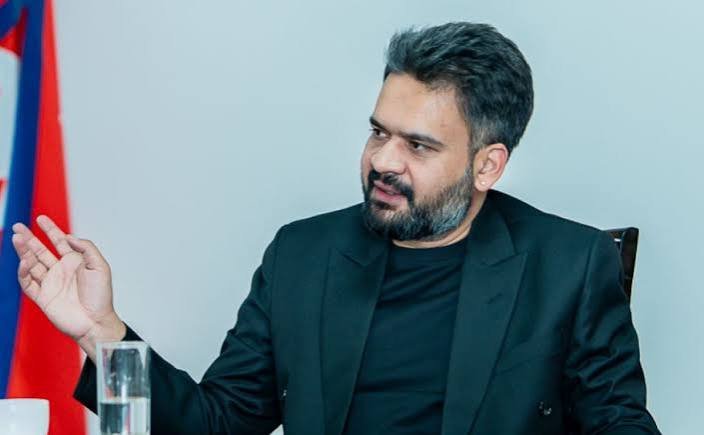
OSLO, Oct 9,2026: South African judge Navanethem “Navi” Pillay, 85, won the Nobel Peace Prize on Friday “for her efforts to promote peace and international law”, the Norwegian Nobel Committee said.
Pillay held states and national leaders accountable and brought hope to victims of violence and conflict, and demonstrated a firm moral compass in her long career, the committee said.
“A common thread runs from her early work defending Nelson Mandela and others who stood up against apartheid to her service as a judge in some of the key international court cases of our time,” the committee said.
Navi Pillay was chair of the United Nations Commission of Inquiry on the Occupied Palestinian Territory that concluded last year that Israel has committed genocide in Gaza. Israel dismissed the report as “scandalous”.
The peace prize is the fifth Nobel awarded this week, after literature, chemistry, physics and medicine. Venezuelan opposition leader Maria Corina Machado won in 2025.
The Nobel Peace Prize, worth 12 million Swedish crowns, or about $1.2 million, is due to be presented in Oslo on December 10, the anniversary of the death of Swedish industrialist Alfred Nobel, who founded the awards in his 1895 will.
October 03, 2026: President Droupadi Murmu has given her assent to the Gujarat Uniform Civil Code (UCC) Bill, 2026, completing a key constitutional step towards its implementation. Gujarat has become the second state after Uttarakhand to secure approval for a Uniform Civil Code, which seeks to establish a common legal framework for personal matters across religious communities.
The legislation will come into force after the Gujarat government notifies the rules. Members of Scheduled Tribes (STs) are excluded from its provisions.
The Gujarat Assembly passed the Bill in March following a seven-and-a-half-hour discussion. Before the legislation was passed by voice vote, Congress legislators staged a walkout and demanded that the Speaker refer it to a Select Committee.
Chief Minister Bhupendra Patel said the legislation would promote equality and national integration. “The key aim of introducing the bill is to ensure social harmony and national unity. The Supreme Court has also suggested that UCC will ensure women’s rights are secured,” he said while introducing the Bill.
What does the Gujarat UCC provide?
The legislation establishes a common framework covering marriage, divorce, succession and inheritance, and live-in relationships, irrespective of religion.
It prescribes a minimum marriage age of 21 years for men and 18 years for women. Couples can solemnise marriages through religious ceremonies or under the Special Marriage Act, but registration is compulsory.
The Code prohibits a second marriage while an existing marriage remains valid, thereby disallowing polygamy. It also invalidates marriages between persons within prohibited degrees of relationship, unless an established custom or usage permits the union and is not contrary to public policy or morality.
The legislation further prohibits nikah halala, a practice requiring a divorced woman to marry another man and obtain a divorce before remarrying her former husband. It provides that divorced spouses can remarry without such a condition. Forcing or abetting the practice attracts legal consequences.
What are the rules for divorce and inheritance?
The Code establishes a common judicial procedure for divorce, replacing religion-specific methods of dissolving marriages, including customary out-of-court procedures and iddat-related processes.
Either spouse may seek divorce on grounds including adultery, cruelty, desertion for two continuous years, religious conversion and incurable unsoundness of mind. Wives have additional grounds where the husband is guilty of rape or an unnatural sexual offence, or has multiple wives from marriages contracted before the Code came into force.
Divorce by mutual consent is permitted if the couple has lived separately for at least one year.
For inheritance, the legislation introduces a common framework for intestate succession, applicable when a person dies without a will. The surviving spouse or spouses, surviving children, branches of predeceased children and surviving parents receive equal shares under the prescribed order of succession. Sons and daughters inherit equally, regardless of religion.
The Code does not alter testamentary succession, meaning property can still be distributed according to a valid will. If no eligible heirs survive, the estate passes to the government through Escheat.
How does the Code regulate live-in relationships?
Registration of live-in relationships is mandatory. Partners must submit a statement to the designated registrar, and couples must notify the authorities when their relationship ends.
A relationship cannot be registered if either partner is a minor, is already married, is in another live-in relationship or falls within a prohibited degree of relationship.
Failure to register a relationship after cohabiting for more than one month can attract imprisonment of up to three months, a fine of up to Rs 10,000, or both. The Bill also provides for a fine of up to Rs 10,000 for non-registration of marriages and divorces.
Children born from live-in relationships are recognised as legitimate children of the couple. Women deserted by their live-in partners can approach a competent court to seek maintenance.
What are the objections and constitutional concerns?
The Opposition criticised the legislation during its passage. Congress MLA Imran Khedawala described it as “against our society” and questioned its benefits, while alleging that the government should focus on other issues concerning Muslim women. AAP MLA Chatar Vasavane alleged that the Bill served electoral interests and raised concerns about its implications for tribal women marrying outside their communities.
Legal concerns also arise from compulsory registration and penalties for live-in relationships. A June 2026 analysis published by The Hindu noted that such provisions raise questions about individual autonomy and the State’s regulation of consensual adult relationships.
In S Khushboo v Kanniammal (2010), the Supreme Court held that morality and criminality are not synonymous and that live-in relationships and premarital sex should not be associated with criminality.
The analysis also cited Deepika Singh v Central Administrative Tribunal (2022), in which the Supreme Court recognised that non-traditional family structures deserve legal protection and social welfare benefits. Critics have been reported to argue that the UCCs do not adequately accommodate such family arrangements, including queer relationships.
Article 44 of the Constitution directs the State to endeavour to secure a Uniform Civil Code for citizens. Uttarakhand implemented its UCC in February 2024, while Gujarat’s law awaits notification of its implementation rules.
Gujarat is the second state after Uttarakhand became first in independent India to implement a Uniform Civil Code on January 27, 2025, introducing a common legal framework governing marriage, divorce, inheritance and live-in relationships, with an exemption for Scheduled Tribes.
New Delhi, September 30,2026: The Union Cabinet on Wednesday approved the Rs 1.86 lakh crore Green Energy Corridor Phase-III scheme to build transmission infrastructure for evacuation of up to 135 GW of renewable power and deploy 50 GWh of battery storage, as India prepares its grid for a sharp expansion in non-fossil energy capacity.Union Minister Ashwini Vaishnaw, announcing the decision after the Cabinet meeting, said adequate transmission capacity would be critical as renewable generation rises, with the government seeking to ensure that grid infrastructure comes up ahead of new renewable projects.A presentation made during the briefing said that without adequate transmission infrastructure, renewable power could face curtailment, and stressed that transmission capacity needed to precede renewable-energy capacity addition.
The scheme, targeted for completion by FY 2032-33, has a total project outlay of Rs 1,86,405 crore.Of this, Rs 1,36,378 crore will go towards strengthening intra-state transmission systems, while Rs 50,000 crore has been earmarked for deployment of 50 GWh of Battery Energy Storage Systems.The Centre will provide financial assistance of Rs 54,082 crore.The scale of the scheme reflects the growing challenge of integrating larger volumes of solar and wind power into the grid. Unlike conventional generation, renewable output varies with sunlight and wind conditions, requiring stronger transmission networks as well as storage to balance supply and demand.The battery systems can be installed at renewable-energy generation sites or other locations considered important for grid flexibility. According to the Cabinet release, they are intended to address intermittency, transmission congestion, peak-hour curtailment and demand during non-solar hours.The government said the corridor will enable evacuation of up to 135 GW of renewable power across states and Union Territories.Vaishnaw’s presentation said India is targeting 500 GW of non-fossil fuel capacity by 2030 and is planning for around 786 GW by 2035-36. The Cabinet release separately said the scheme would contribute towards the longer-term target of 900 GW of installed non-fossil capacity by 2035.India’s rapidly expanding solar capacity is already increasing the need for supporting grid infrastructure. According to an official PIB backgrounder, India’s installed solar capacity had reached 162.15 GW by June 30, 2026, up from around 3 GW in 2014. :chatgpt-content-reference{index=”0″}Under GEC-III, all new or greenfield intra-state transmission projects will be awarded through tariff-based competitive bidding.Transmission service providers selected through the bidding process will build, own, operate and maintain the assets, while State Transmission Utilities will act as the overall implementing agencies.Upgradation and strengthening of existing, or brownfield, transmission networks will be carried out on a cost-plus basis.The government said the central assistance would help offset intra-state transmission charges and limit their impact on electricity costs for consumers.The scheme also marks a significant expansion of India’s Green Energy Corridor programme, which was originally designed to strengthen transmission networks in states with high renewable-energy potential.With renewable generation expanding faster, the focus is increasingly shifting from merely creating generation capacity to ensuring that electricity can be transmitted, stored and supplied when it is needed.
Patna, Sep 29,2026: The Patna High Court has held that pension benefits of a retired government employee cannot be withheld indefinitely through prolonged departmental proceedings and observed that pension constitutes a right to property protected under Article 300-A of the Constitution.
The ruling came in the case of retired Assistant Engineer Mahendra Ram of the Bihar Water Resources Department, whose retirement benefits remained partly withheld for years following disciplinary proceedings relating to an alleged illegal withdrawal of Rs 48,000. Justice Purnendu Singh, while hearing the matter, took serious note of the prolonged delay in concluding the departmental proceedings and observed that an unexplained and continuing delay in determining the retiral dues of a government employee can cause serious mental agony as well as financial hardship.
The court directed the State authorities to conclude the pending proceedings within six weeks. It further ordered that if the State failed to complete the proceedings within the stipulated period, the disciplinary proceedings would stand terminated, according to the order.
In such an eventuality, the authorities have been directed to release Ram’s pending retirement benefits, including his full pension, gratuity, and leave encashment, within a further period of two weeks. Ram had retired from government service in April 2020. Proceedings had been initiated against him in connection with the alleged withdrawal of Rs 48,000 from government funds.
According to the case put forward before the court, subsequent departmental inquiry did not establish that Ram had committed the alleged financial irregularity. The responsibility for the withdrawal was attributed to an Account Clerk, against whom disciplinary action was subsequently taken.
Despite the proceedings, Ram was granted only 90 per cent of a provisional pension, while the final determination of his retirement benefits remained pending. The court emphasised that a pension is not a bounty or a discretionary payment dependent solely on the will of the government, but a legally protected entitlement of a retired public servant.
The ruling also underscores the requirement for the State authorities to act within a reasonable and legally permissible period while dealing with disciplinary proceedings having a direct bearing on an employee’s retirement benefits.